This Week in Sound: “How Owls Achieve Silent Flight”

A lightly annotated clipping service

These sound-studies highlights of the week originally appeared in the January 30, 2024, issue of the Disquiet.com weekly email newsletter, This Week in Sound. This Week in Sound is the best way I’ve found to process material I come across. Your support provides resources and encouragement. Most issues are free. A weekly annotated ambient-music mixtape is for paid subscribers. Thanks.

▰ CLONE WARS: “Your group should set up a password for situations where you need to confirm identities over the phone. Let’s say it’s ‘raspberry beret.’ If you get a call from a loved one in trouble, you can say, ‘Look, there are scams, and we talked about this — what’s the password?’ The password should be something familiar that’s easily remembered but not associated with you online. A family joke can be good. You don’t have to be strict about them getting it perfect—you’re not verifying their nuclear launch code authority.” —Glenn Fleishman shares advice for avoiding the trap of voice deepfakes.

▰ FRINGE SCIENCE: Science still has much to learn about how owls fly so silently: “Previous studies have found a link between noiseless flight and the presence of micro-fringes in owl wings. These are referred to as ‘trailing-edge’ (TE) fringes. These appear to be the crucial factor in quiet owl flight. … ‘Despite many efforts by many researchers, exactly how owls achieve silent flight is still an open question,’ says senior author Professor Hao Liu from the Graduate School of Engineering at Chiba University in Japan. ‘Understanding the precise role of TE fringes in their silent flight will enable us to apply them in developing practical low-noise fluid machinery.’”

▰ QUICK NOTES: FM Blues: A radio station, WERA 96.7 in Arlington, Virginia, has been playing lofi beats on loop non-stop since the start of December 2023, due to delays in the station’s relocation. (Thanks, Mike Rhode!) ▰ Long Now: “639-year organ performance” of a work by John Cage continues apace in Germany. (Thanks, Alan Bland!) ▰ Water Log: Sonar may — keyword: may — have discovered the remains of Amelia Earhart’s plane. ▰ In Sync: A musician and sound designer waxes rhapsodic over the moments when the two blend. ▰ Ah Om: A friend of one of the creators of the Buddha Machine shares some stories about their development. ▰ Ear Witness: Shazam can now identify what song you’re listening to while you have headphones on. ▰ Good Fences: A lovely blog entry, complete with ample photography and audio examples, by Sean Julian on making “vibration recordings,” in which he listens to fences(Thanks, Grant Wilkinson!) ▰ Cold Truth: These date back to September of last year, when the Clean Arctic Alliance launched a campaign about underwater noise pollution:
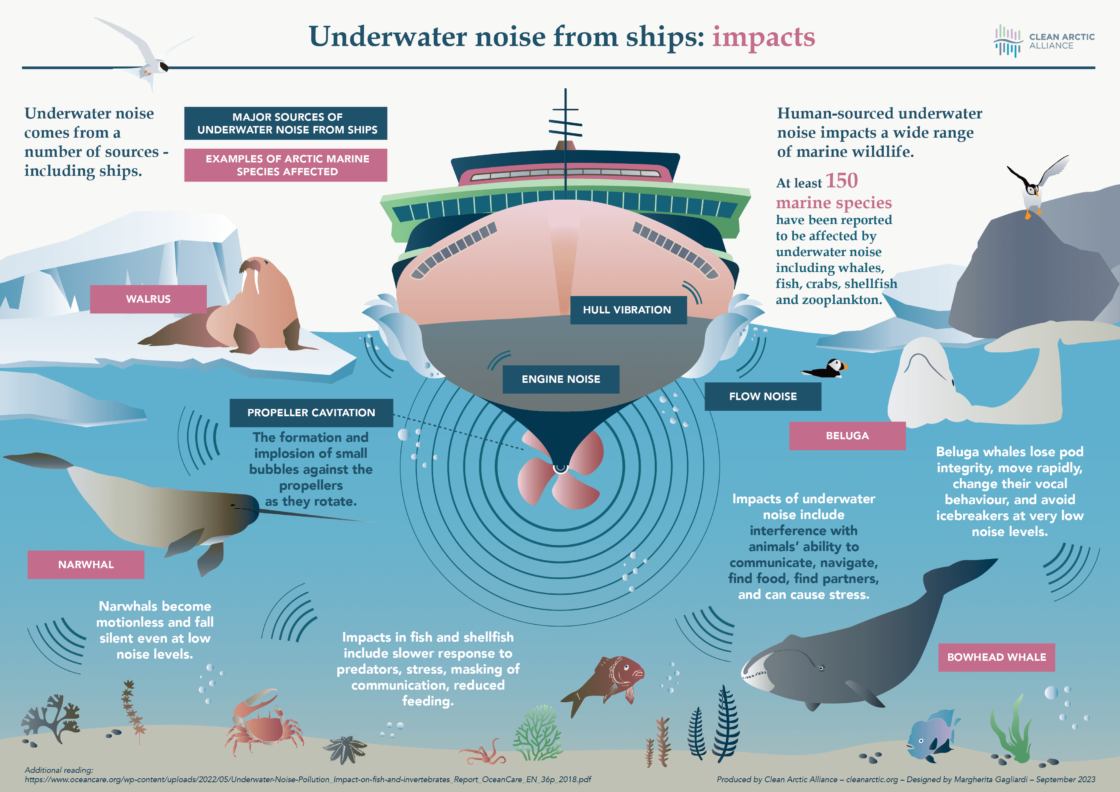
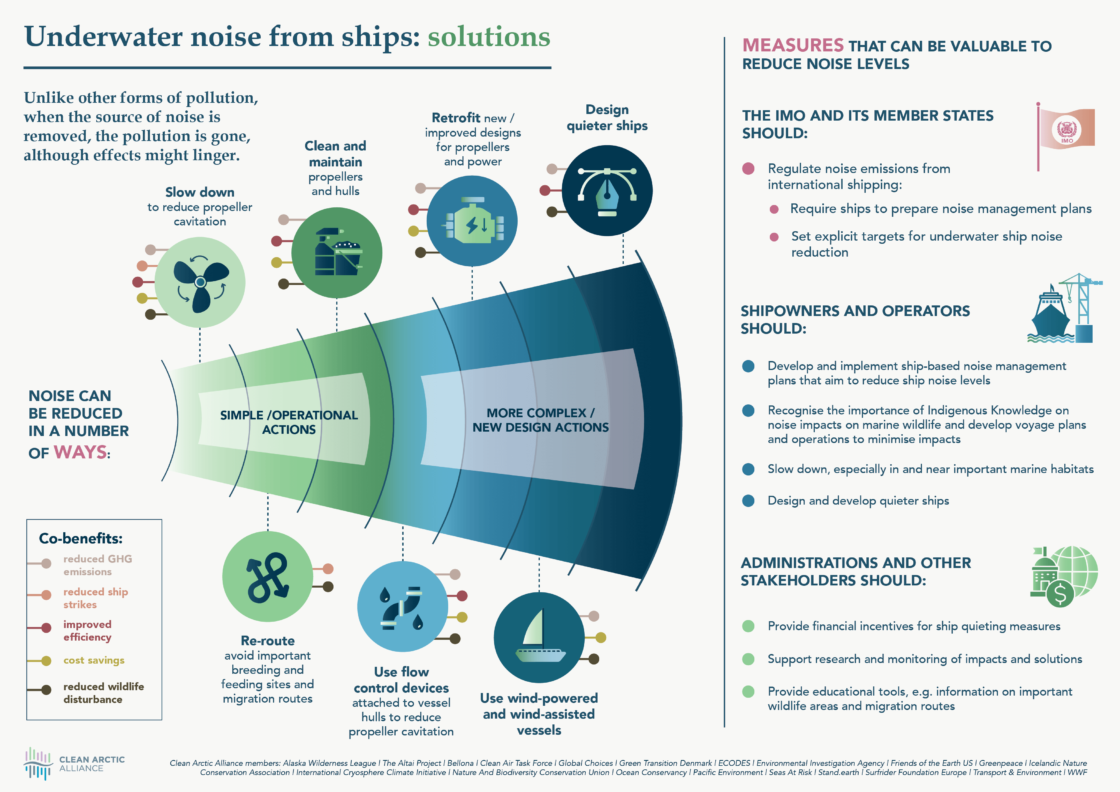
I only had room for one of these in the issue, but here’s a second Clean Arctic Alliance infographic:
On the Line: Physics, Design, LightSound

Some favorite recent sentences

“Deep neural network for learning wave scattering and interference of underwater acoustics”

Sometimes science is, to the rest of us, abstract poetry. The above is the title of a research paper to be published in the Physics of Fluids journal about an innovation “that harnesses the power of AI to accurately model how sound waves travel underwater [and] could help reduce the impact of noise pollution on marine life.”

. . .

"To find sources of real sound of people in pain is convincing, and the credibility of the sound you use is so important because you can fool the eye much more easily than you can the ear."

That is Oscar-nominated sound designer Johnnie Burn talking to Salon’s Gary M. Kramer about the production of the Holocaust film The Zone of Interest, based on a Martin Amis novel.

. . .

"This device isn’t just for a blind or low-vision person. It could also be a tool for a person that engages with data differently."

That is Harvard astronomy lab manager Allyson Bieryla talking to National Geographic’s Stephanie Vermillion about LightSound, “a smartphone-sized device that translates ambient brightness into sound.”

Sound Ledger: Deepfake Forensics

Audio culture by the numbers

250: Length in milliseconds of the segments employed to identify details about the headline-making deepfake of U.S. president Joe Biden

155: Total number of segments employed in the forensic effort

122: Number of text-to-speech engines (and other technological tools) included in the research data set

Source: pindrop.com.

Speak, Memory — or at Least Instapaper

On text-to-speech interfaces and app adoption

I’ve been trying out various apps and services that facilitate the collection of browser-based documents. I don’t need much in terms of long-term collation, mostly items on a week-by-week basis, mostly for my This Week in Sound newsletter. Instaper is a leading such option. There are also: Pocket, synced bookmarks (I’m a longtime user of pinboard.in, just shy of a decade), and the Read Later panel in the Safari browser, among numerous — some days it feels like countless — other options.

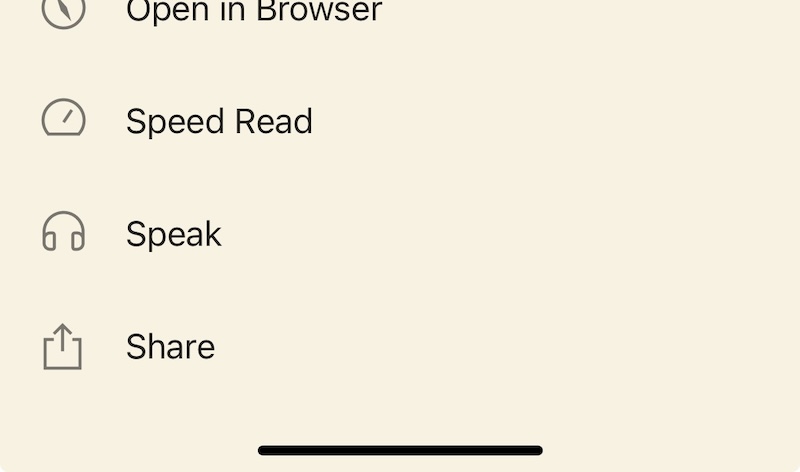
These tools have their pros and cons, their pluses and minuses, and they have their idiosyncrasies. Some, including Instapaper, allow you to hear a document read back to you — what’s referred to as “text-to-speech.” What struck me in particular about Instapaper is the voice implementation (perhaps archaic, as text-to-speech goes) and also an aspect of the text-to-speech interface, which displays the following:

It shows a pair of headphones next to the word “Speak.” The headphones icon suggests one listens, which is appropriate. The word “Speak” suggests — and I say this at the risk of, you know, jumping to a conclusion — that the user speaks, which is counterintuitive. Why, I ask, doesn’t this show headphones and the word “Listen”? Especially today, in a time of widespread speech-to-text utilization.

Complicating the scenario further is the phrase “Speed Read” directly above. This is, in fact, an especially idiosyncratic function within Instapaper. What it does is flash the words, one at a time. For some people this is apparently a means for reading quickly. For others it might feel like being a subject of brainwashing in A Clockwork Orange.

In any case, what matters is that the appearance of “Speed Read” above “Speak” gets confusing, because “Speak” is the tool that reads to you, and “Speak” in fact does have a submenu that lets you adjust the speed at which it reads to you. You can see how this can become not so much confusing as concerning. Odd incongruences can taint an interface and, by extension, a product.

There’s a thing about utilities like Instapaper, and I think of it as the “if only” factor, for every app has its little shortcomings: if only it was cheaper, if only it didn’t have a subscription cost, if only it had folders, if only the fonts appealed to me, if only it worked offline, if only it were cross-platform, and so forth. If Instapaper didn’t have this text-to-speech feature, I might not have missed it. Since the app has the feature, I find myself factoring my relative satisfaction with the implementation into my decision-making in terms of adoption.

I have a lot of friends who swear by Instapaper, and several of them didn’t even know about or at least don’t use the “Speak” function. It all comes down to personal habits, but personal habits in aggregate are a powerful force in the development and evolution of interface norms. It’s somewhat difficult to imagine that the word “Speak” next to a pair of headphones will become the universal symbol of text-to-speech. Note, above, how the New York Times, which recently launched its own audio-specific service, signals the same feature on its main website. And below is how The New Yorker, on its website, which has actual humans (not digital facsimiles toiling tirelessly syllable by syllable) doing the reading, highlights the availability:

And no, I still haven’t decided on an option. But such is digital life.

On Repeat: Birdsong, Iceberg, Cello

Home/office playlist

I try to at least quickly note some of my favorite listening from the week prior — things I’ll later regret having not written about in more depth, so better to share here briefly than not at all.

▰ This is a live performance reworking of sounds from the forest, emphasis on the birdsong, by Mark Harrop, aka UMCorps, based in Cornwall in the U.K. He employs various techniques on “Endless Woodland,” like pitch-shifting as well as the re-insertion of samples from the original material, turning the source audio into something cinematic, a combination of the everyday and the psychological experience of an imagined scenario.

▰ Heejin Jang’s new album, Human Iceberg, is the score to a collaborative project by that name that teams her with writer Lim Jina and visual artist Lee SunHo on what sounds, from the description, like a science fiction fable about climate change. Jang scored the project, expressing various settings, from the melting of an iceberg to technological failures to seemingly supernatural occurrences. While there are atmospheric moments, it gets loud; as Jang says on her Bandcamp page’s bio: “I make something noisy.” More at instagram.com/humaniceberg.official, best viewed on a laptop or desktop computer. Jang is based in Seoul, Korea.

https://heejinjang.bandcamp.com/album/human-iceberg

▰ Henrik Meierkord’s cello, sounding like it’s deep in cavern, combines on “Warum” with the samples and tape work of Marco Lucchi, moaning swells that turn the piece into a sort of conversation between the instruments. Meierkord is based in Sweden, Lucchi in Italy.