
This track is archival, but it also serves as a current, potent little reminder of what’s going on at bassist-producer [Bill Laswell’s quickly expanding Bandcamp page](https://billlaswell.bandcamp.com/). The track dates from 1993, recorded the year prior for Japanese drummer Hideo Yamaki’s album *Shadow Run*. It [popped up today](https://billlaswell.bandcamp.com/track/hoisasa) on Laswell’s Bandcamp outpost. Like many Laswell productions, *Shadow Run* appears under an individual’s name, but that name stands in for a wide swath of favorite session players, among them Foday Musa Suso (kora, vocals), Bernie Worrell (organ), Toshinori Kondo (trumpet), and Laswell himself. And, on this track, the great Ginger Baker. The track, “Hoisasa,” is a duo of Baker and Yamaki going at their kits, sometimes in swinging unison, often in swaggering counterpoint. It’s a force of nature collaboration. Two other releases under Yamaki’s name also appear on Laswell’s page, both duos with Laswell himself.
Listening to Yesterday: Branded Interference
The digital signature of media failure

I started using an additional video streaming service. Its interface was just different enough from those of other streaming services that my brain had to adjust during the early stages of adoption. Even when watching a TV episode or a movie within a given service, there is a layer of service-specific interface design. It can take awhile for that layer to become mentally invisible, brand transparent, aesthetically neutral. The same can be said of its interference.
There is no truly blank canvas in digital media. One service shows a more granular level of stills during fast forward and reverse, while another does a better job of adjusting to your TV screen, and yet another seems more finicky than its competitors about just how low-rez it’ll consider displaying an image when, for whatever reason, the wifi is sluggish. If the wifi drops below that service’s effete threshold, it defaults to a signal-error screen, while all the other services seem happy to serve up a glitchy entertainment of blocky, vaguely familiar images that suggest Chuck Close trying to give Bill Viola a run for his installation money.
This new service had hit a slow spell, and the screen reverted to a melty image that brought to mind an overplayed VHS cassette, or more to the point the digital simulation of an overplayed VHS cassette on some contemporary retro drama set in the penultimate-lapsarian era of early Internet adoption. The audio held for awhile, so my brain knew who was talking. I began to wait out the low-fidelity spell like one might a snow storm or a case of indigestion. The TV snow of my youth came to mind, but this was something else entirely, a mutant hybrid, half-noise, half-signal.
And then the audio itself gave, the music and voices intermingling into some sludgy, broken stream of consciousness. The effect was familiar but distinct from the failures of other streaming services, which ran different technology on different hardware in different clusters of geolocated farms of different servers. This glitch sounded different from the other services’ subpar moments. It seemed that even the interference was branded, bearing an imprint that was an artifact of countless decisions encoded into the stream. Yesterday this interference felt new, and for some time it will be recognizable. At some point will it, too, become generic, transparent, neutral?
*(Photo by fdecomite, used via [Flickr](https://flic.kr/p/8tsb24) and [a Creative Commons license](https://creativecommons.org/licenses/by/2.0/).)*
Listening to Yesterday: Light and Truth
A tale of mundane synesthesia

“What is that sound,” Billy Bragg once sang. “Where is it coming from?” He was not describing the room in my home where something, yesterday, was ringing. For awhile I thought it was just my ears — allergies, age, perhaps a cold. I heard the ringing, but figured it might be internal. Then someone else came in and asked what the sound was. Aside from my laptop, there was nothing on that might emit sound. The guitar amp was off, the modular synthesizer was off, a handful of musical gadgets were off. Even the power strip into which most of them were plugged was off. This was all self-evident in the bright room.
I turned off the light switch on the wall. The room went dark, except for the bit of sunlight that made it through the drawn blinds. The room also went silent. The sound had something to do with the light fixture that hung from the ceiling. I turned the light switch on, slowly, and the room began to become more visible. The sound was gone. The room, however, was darker than it had been. Minutes ago two incandescent bulbs had filled the room with light and sound. Now one of the bulbs was dead. That whine, that electric buzz, had had something to do with the now dead bulb’s last moments of function. I pictured its filament, close to the breaking point, the tension in its failing, spring-like connection, before it finally had given way.
*(Photo by Dave Crosby, used via [Flickr](https://flic.kr/p/cmFdVE) and [a Creative Commons license](https://creativecommons.org/licenses/by-sa/2.0/).)*
Listening to Yesterday: Avoiding Claustrophonia
That droning feeling
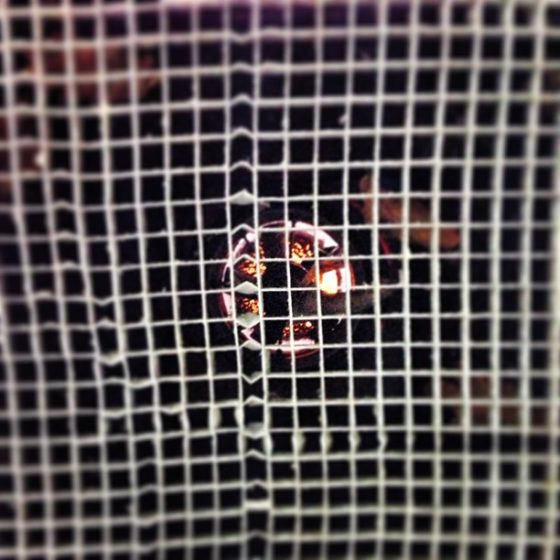
There was a hum in the air, a fast-cycling white noise that filled the room. The room’s one door was closed, and its windows, in order for the machine making the noise to have its full effect. The machine was a powerful air purifier, an allergy-related device designed to pull dust from the room and adhere it to an easily removable filter, a robust one that could last months before disposal. The hum wasn’t merely a presence in the room. When turned on, the device’s fuzzy droning consumed the room. Like a quiet talker who draws in listeners, the machine seemed to pull the walls closer, an impression furthered by the closed door and windows. The outside world lost any presence. Not a siren or a bird or a passing bus was heard for the duration. The use of the machine was never a claustrophobic experience —Â never a claustrophonic experience. There was an intimacy to it, womb-like, comforting. The therapeutic purpose of the machine provided a positive association with the hum. I wondered if the company that manufactured the machine had worked to tune it, to give it a hum that was pleasant despite being so present, one that felt ameliorative rather than threatening. I wondered if, over time, the hum might alter — erode, degrade — and someone, the equivalent of a piano tuner, would have to come to my home and adjust it.
*(Photo by Kent, used via [Flickr](https://flic.kr/p/dYYcDi) and [a Creative Commons license](https://creativecommons.org/licenses/by-nc/2.0/).)*
Disquiet Junto Project 0243: Synth Trial
The Assignment: Share the best track from your audition tape for Blade Runner 2.

Each Thursday in the [Disquiet Junto group](https://disquiet.com/junto/), a new compositional challenge is set before the group’s members, who then have just over four days to upload a track in response to the assignment. Membership in the Junto is open: just join and participate. A SoundCloud account is helpful but not required. There’s no pressure to do every project. It’s weekly so that you know it’s there, every Thursday through Monday, when you have the time.
Tracks will be added to this playlist for the duration of the project:
This project was posted in the morning, California time, on Thursday, August 25, 2016, with a deadline of 11:59pm wherever you are on Monday, August 29, 2016.
These are the instructions that went out to the group’s email list (at [tinyletter.com/disquiet-junto](http://tinyletter.com/disquiet-junto)):
Disquiet Junto Project 0243: Synth Trial
The Assignment: Share the best track from your audition tape for *Blade Runner 2*.
Please pay particular attention to all the instructions below, in light of SoundCloud having closed down its Groups functionality.
Big picture: One thing arising from the end of the Groups functionality is a broad goal, in which an account on SoundCloud is not necessary for Disquiet Junto project participation. We’ll continue to use SoundCloud, but it isn’t required to use SoundCloud. The aspiration is for the Junto to become “platform-agnostic,”which is why using a message forum, such as llllllll.co, as a central place for each project may work well.
And now, on to this week’s project.
Project Steps:
Step 1: As you now know, Jóhann Jóhannsson was selected to score *Blade Runner 2*. The news means, among other things, that you didn’t get the gig. Please reconcile yourself with this.
Step 2: Please share your favorite track from the audition tape you sent to Ridley Scott.
Five More Important Steps When Your Track Is Done:
Step 1: Per the instructions below, be sure to include the project tag “disquiet0243”(no spaces) in the name of your track. If you’re posting on SoundCloud in particular, this is essential to my locating the tracks and creating a playlist of them.
Step 2: Upload your track. It is helpful but not essential that you use SoundCloud to host your track.
Step 3: This is a fairly new step, if you’ve done a Junto project previously. In the following discussion thread at llllllll.co post your track:
http://llllllll.co/t/disquiet-junto-project-0243-synth-trial/4288
Step 4: Annotate your track with a brief explanation of your approach and process.
Step 5: Then listen to and comment on tracks uploaded by your fellow Disquiet Junto participants.
This project was posted in the morning, California time, on Thursday, August 25, 2016, with a deadline of 11:59pm wherever you are on Monday, August 29, 2016.
Length: The length is up to you. Three minutes seems like a good maximum.
Title/Tag: When posting your track, please include “disquiet0243”in the title of the track, and where applicable (on SoundCloud, for example) as a tag.
Upload: When participating in this project, post one finished track with the project tag, and be sure to include a description of your process in planning, composing, and recording it. This description is an essential element of the communicative process inherent in the Disquiet Junto. Photos, video, and lists of equipment are always appreciated.
Download: It is preferable that your track is set as downloadable, and that it allows for attributed remixing (i.e., a Creative Commons license permitting non-commercial sharing with attribution).
Linking: When posting the track online, please be sure to include this information:
More on this 243rd weekly Disquiet Junto project — “Share the best track from your audition tape for *Blade Runner 2*”— at:
https://disquiet.com/0243/
More on the Disquiet Junto at:
https://disquiet.com/junto/
Subscribe to project announcements here:
http://tinyletter.com/disquiet-junto/
Project discussion takes place on llllllll.co:
http://llllllll.co/t/disquiet-junto-project-0243-synth-trial/4288
There’s also on a Junto Slack. Send your email address to twitter.com/disquiet for Slack inclusion.