What Sound Looks Like

An ongoing series cross-posted from instagram.com/dsqt

Generally speaking the word “doorbell” relates to a device, usually electric but occasionally purely mechanical, that mediates human interaction by providing an inhabitant with news of the arrival of a visitor, and the option to ignore it. There is another type of doorbell, like this set that dangles from inside the unlocked front gate of a friend’s home. When they ring, the door already has been opened. They are, in effect, a doorbell after the fact.

An ongoing series cross-posted from instagram.com/dsqt.

Disquiet Junto Project 0232: No Input

The Assignment: Record a piece of music exploring the concept of "no-input mixing."

andypiper

Each Thursday in the Disquiet Junto group on [SoundCloud.com](https://soundcloud.com/groups/disquiet-junto/) and at [disquiet.com/junto](https://disquiet.com/junto/), a new compositional challenge is set before the group’s members, who then have just over four days to upload a track in response to the assignment. Membership in the Junto is open: just join and participate. There’s no pressure to do every project. It’s weekly so that you know it’s there, every Thursday through Monday, when you have the time.

Tracks will be added to this playlist for the duration of the project:

This project was posted in the afternoon, California time, on Thursday, June 9, 2016, with a deadline of 11:59pm wherever you are on Monday, June 13, 2016.

These are the instructions that went out to the group’s email list (at [tinyletter.com/disquiet-junto](http://tinyletter.com/disquiet-junto)):

Disquiet Junto Project 0232: No Input

The Assignment: Record a piece of music exploring the concept of “no-input mixing.”

This week’s project explores the concept of no-input mixing. For background, including a tutorial, this Synthtopia article, summarizing more detailed coverage by the Department of Performance Studies at Texas A&M, might prove useful:

No Input Mixing Tutorial

Step 1: Read up, if it’s not already familiar, on the concept of “no-input mixing,” which involves creating feedback by taking the output of a mixer and plugging it into the input of the same mixer, thus exposing and building on inherent (i.e., noisy) sonic properties of the device.

Step 2: Experiment with no-input mixing.

Step 3: Record a short piece of no-input mixing music.

Step 4: Upload your completed track to the Disquiet Junto group on SoundCloud.

Step 5: Annotate your track with a brief explanation of your approach and process.

Step 6: Then listen to and comment on tracks uploaded by your fellow Disquiet Junto participants.

Deadline: This project was posted in the afternoon, California time, on Thursday, June 9, 2016, with a deadline of 11:59pm wherever you are on Monday, June 13, 2016.

Length: Length is up to you, though between two and three minutes seems about right.

Upload: Please when posting your track on SoundCloud, only upload one track for this project, and be sure to include a description of your process in planning, composing, and recording it. This description is an essential element of the communicative process inherent in the Disquiet Junto. Photos, video, and lists of equipment are always appreciated.

Title/Tag: When adding your track to the Disquiet Junto group on Soundcloud.com, please in the title to your track include the term “disquiet0232.”Also use “disquiet0232”as a tag for your track.

Download: It is preferable that your track is set as downloadable, and that it allows for attributed remixing (i.e., a Creative Commons license permitting non-commercial sharing with attribution).

Linking: When posting the track, please be sure to include this information:

More on this 232nd weekly Disquiet Junto project — “Record a piece of music exploring the concept of ‘no-input mixing.'” — at:

https://disquiet.com/0232/

More on the Disquiet Junto at:

https://disquiet.com/junto/

Join the Disquiet Junto at:

http://soundcloud.com/groups/disquiet-junto/

Subscribe to project announcements here:

http://tinyletter.com/disquiet-junto/

Disquiet Junto general discussion takes place at:

https://disquiet.com/forums/

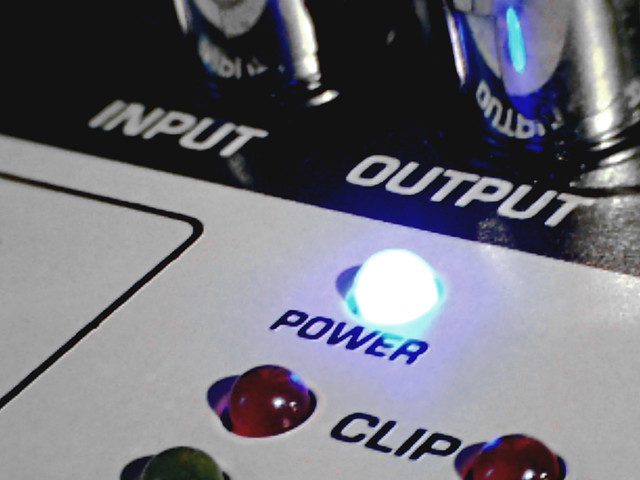
Image associated with this project is by Andy Piper and it is used thanks to a Creative Commons license:
Switched on

One Synthesizer, Multiple Voices

A work for modular synth by Fastus

Different musicians have different audiences. The thing that distinguishes SoundCloud from most music services is how people use it to post half-done pieces, sometimes with their “listener” audience in mind, often with their “peer” audience, the latter meaning other musicians, who are, of course, often listeners themselves. On video sites, “unboxing” and intro “tutorial” or “overview” clips let new owners share some of their consumerist energy, and occasionally even some tips. On SoundCloud, the closest comparison might be “first try” or “first take” audio, when musicians post a very early attempt to use a new piece of equipment. That subset of audio is followed by instrument-centric recordings, like this piece by Fastus, in which the equipment may not necessarily be new, but it still has the spotlight. “Isolation,” as it’s called, is a modular synthesizer piece that, per the very brief (eight-word) liner note, is based around a single item of equipment, the Telharmonic (from the company Make Noise), which came out [a little under a year ago](http://www.synthtopia.com/content/2015/08/03/make-noise-intros-telharmonic-multi-voice-multi-algorithm-eurorack-module/). It’s a remarkable recording, multiple voices moving throughout, cycling and echoing each other, built largely from organ-like tones and a rhythm that sounds like steam pipes opening and closing.

Track originally posted at [soundcloud.com/fastus](https://soundcloud.com/fastus/isolation). Fastus is Ian O’Brien of Jersey City, New Jersey. More from him at [twitter.com/FastusMusic](https://twitter.com/FastusMusic).

Query for Junto Participants

To chat or not to chat – and where, and how

I sent an email out to the Disquiet Junto announcement list. The tl;dr version of this email is:

*Would you participate in a Slack channel for Junto members, or are there other places you’d find useful for member communication?*

The main uses for communication I’ve seen are:

Ӣ project-specific chatter (current, future)

Ӣ compositional/productivity tips

Ӣ gear/technique tips

Ӣ Junto satellite operations (concerts, albums, etc.)

Ӣ long-distance, asynchronous camaraderie (varied, naturally)

A Massive Yet Nearly Invisible Music Machine

Ellen Fullman teams with a Box Bow quartet

The video posted [yesterday](https://disquiet.com/F1uep) by the Lab, the experimental San Francisco arts and performance space, of Ellen Fullman focused on her Long String Instrument’s central quality: its tonal richness. A 50-plus-foot series of parallel strings, Fullman’s creation puts the musician — and to some extent the live audience — inside a massive yet nearly invisible music machine. As a result of dimensions, construction, and situation, the Long String Instrument excels at tonal material that balances harmonic complexity with an aesthetic sparsity.

In yesterday’s video, an excerpt of the piece “Harbors,” Fullman’s instrument was complemented by Theresa Wong’s cello, both live and repurposed thanks to a laptop. In the video posted today, which like yesterday’s is sourced from a month-long residency by Fullman at the Lab at the start of 2016, the music is more song-like, less ethereal, more earthy. This association is less because of the number of additional strings (she plays with four members of the makeshift Box Bow Ensemble, which was assembled specifically for the event), and more to do with the folk-like pacing of the piece.

The first half the video (an excerpt of a longer performance titled “Past the Angels”) rolls along at about 89 beats per minute, slowly varying the same central collaborative musical phrase, like each member is strumming the strings of some gargantuan autoharp. And then it begins to dissolve. One member of the ensemble, Crystal Pascucci, breaks from her Box Bow and strums the Long String Instrument and, later, both her own Box Bow and another. The group plays against each other, taking on a more phase-like scenario, in which the phrase is shifting, the downbeat uncertain, the cyclic nature more hallucinatory.

This description is from a note at the Lab site:

>“Past the Angels”is a work for an ensemble of four performing on Fullman’s Long String Instrument using the Box Bow, a hand-held wooden tool used to strike the strings in a percussive manner. Seasoned Bay Area composer/performers Mark Clifford, David Douglas, Ryan Jobes and Crystal Pascucci will play the hocketed box bow parts. In this work, Fullman brings together the ethereal and the folk-inspired possibilities of her instrument.

The video was first posted on [the Lab’s YouTube channel](https://www.youtube.com/watch?v=Geghvmf57b4). It’s the latest piece I’ve added to my ongoing YouTube playlist of fine [“Ambient Performances.”](https://disquiet.com/2016/04/30/a-youtube-playlist-of-ambient-performances/) More from Fullman at [ellenfullman.com](http://ellenfullman.com).