“Bassel K”

An essay I wrote for The Cost of Freedom, dedicated to detained Creative Commons coder/artist Bassel Khartabil Sadafi

20151109-costoffreedom

“Bassel K” is a short essay I wrote for the book *The Cost of Freedom: A Collective Inquiry*, which was published today, November 9, 2015, to draw attention to the continued detainment in Syria of Bassel Khartabil Sadafi. The publication came together as part of a “book sprint” held in Pourrières, France, from the 2nd to the 6th of November. (I wasn’t in France. I was home, typing in San Francisco.) Contributors include Lawrence Lessig, Lucas Gonze, Barry Threw, Niki Korth, and Jon Phillips, among many others. Bassel has been held since March 15, 2012.

We’ve done two Disquiet Junto projects related to Bassel’s detainment. On the third anniversary of his seizure, March 12, 2015, we focused our imaginations on the silence of a closed room: [“Disquiet Junto Project 0167: Placid Cell.”](https://disquiet.com/2015/03/12/disquiet0167-freebassel/) Previous to that, back on January 23, 2014, as described in the essay below, we expanded on one of his works-in-progress, creating an imaginary soundscape to the ancient city of Palmyra: [“Disquiet Junto Project 0108: Free Bassel.”](https://disquiet.com/2014/01/23/disquiet0108-freebassel/)

And here is the essay:

>”Bassel K”
>
>I read The Trial at too young an age. It instilled in me many things, some of them even positive, such as an affection for Franz Kafka, an aspiration to taut structure, and a desire to tell stories. It also haunted me, and it does to this day. It imprinted on me an intense fear of undeserved imprisonment.
>
>I was introduced to the imprisonment of Bassel Khartabil by three remarkable people: Niki Korth, Jon Phillips, and Barry Threw. They are in many admirable ways as free as Bassel is not. Each of the trio is dedicated to their own individual and collective artistic pursuits to explore the deep potential where technology and culture meet. They make and celebrate the things that make today a special time.
>
>And they know full well that all is not right in our time. They expend significant energy in building awareness of the ongoing fact of Bassel’s murky, tragic legal status. At their suggestion, back in January 2014, I gathered musicians to highlight Bassel’s plight. These musicians participate collectively in something called the Disquiet Junto. It’s a freeform group I moderate that each Thursday responds to music-composition prompts. The idea behind all the prompts is that creative constraints, such as those employed in Oulipo and Fluxus, are a useful springboard for creativity and productivity.
>
>The Junto’s fondness for such “constraints” met a fierce complement when we tackled Bassel’s situation, which is that of a most uncreative form of constraint. There were many ways we could have paid tribute to Bassel. What we elected to do in the Junto was to keep one of his projects going: He may be in jail, but his art could continue to develop. Prior to Bassel’s arrest on March 15, 2012, in Damascus, he was working on several projects. Among them was a three-dimension computer rendering of the ancient city of Palmyra. What we in the Junto did was make “fake field recordings”: audio of what the halls of Palmyra’s structures might have sounded like millennia ago. Much as Bassel was trying to revive an ancient world, the Junto participants were, in essence, keeping one of his projects alive while he is incapable of doing so. And, of course, building upon his artistic efforts was true to the ethos of the Creative Commons, in which Bassel has been profoundly engaged.
>
>We had no idea, of course, back in early 2014 that Palymra would itself receive worldwide attention when ISIS, the extremist movement, would in 2015 move to destroy much of the ancient city’s remaining architectural history — or that, later still, Russian warplanes would further damage the site. This is one of Kafka’s lasting legacies: just when things seem horrible, they can and do get worse.
>
>Palmyra has fallen. Bassel remains in jail. The challenge to rectify his situation has long since surpassed the overly employed term “Kafkaesque.” Someone must have been telling lies about Bassel K, because he is still kept from his freedom. But as long as he is in prison, there are plenty of people telling his story, and keeping his work alive.

Below is a shot of Bassel in happier times, and an image from his “3D Palmyra” work mentioned in my essay:

20151109-basselcc

20151109-palymyra

More on the book *The Cost of Freedom: A Collective Inquiry*, which is in the public domain and is available as an [ePub](http://costoffreedom.cc/uploads/Cost-of-Freedom.epub) and [PDF](http://costoffreedom.cc/uploads/CostOfFreedom_web.pdf), at [costoffreedom.cc](http://costoffreedom.cc/).
Nicklas Lundberg’s Aleatoric Voicings

Like the Roches covering Arvo Pärt

Nicklas Lundberg of Sweden uploads audio to SoundCloud under the various names, including Back Porch and Entryway. These appear not to be names, however, so much as points of orientation. Lundberg lists “Entryway” as his “main account,” which makes “Back Porch,” in contrast, a place where he presumably tends to his less common creative practices. One hopes that the practices that inform the dramatically titled “Greater Duophonic Mass Part 02 – (parallel modes and aleatoristic melodies for long digital notes)” become more common for Lundberg, because the results are beautiful — harrowing at times, yes; emotionally draining even, yes. But, beautiful nonetheless, like the Roches covering Arvo Pärt around a camp fire. It’s a nearly 20-minute piece of layered singing, the parts passing with the chance criss-crossing hinted at in the title (the “aleatoric” part). At times a voice comes to the fore, a deep groan or a high, piercing screech, but it all, in the end, is subsumed into the mass. That’s “mass” in both the density and liturgical sense of the word.

Track originally posted at [soundcloud.com/nlundberg2](https://soundcloud.com/nlundberg2/greater-duophonic-mass-part-02-parallel-modes-and-aleatoristic-melodies-for-long-digital-notes). More from Lundberg at [soundcloud.com/nlundberg](https://soundcloud.com/nlundberg).

Report from the (Real) Future (Fair)

A few hundred people listen to the Junto with their eyes closed – plus clairaudient journalism (Nov 6-7, 2015)

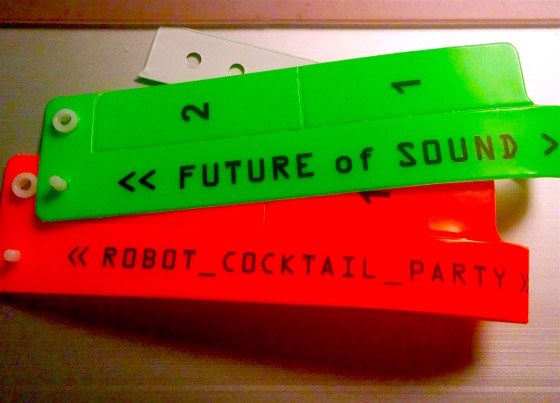
20151108-realfuture

As you can perhaps deduce from the unused drink tickets that remain attached to these two wristbands, I had a pretty debilitating head cold during the Real Future Fair in San Francisco on November 6 and 7. I did, though, have the great opportunity to share the fruits and nearly four-year history of the Disquiet Junto in a short presentation during the Fair’s closing night “Future of Sound” event.

This appearance meant, among other things, sharing a bill with soul-pop figure Kelela, Hrishikesh Hirway of the Song Exploder podcast, San Francisco electronic musician Pamela Z, and performance artist Dia Dear, as well as a bunch of journalists from Real Future and its parent media organization, [fusion.net](http://fusion.net). Head cold or not, that was pretty grand.

Some quick highlights of the Fair:

— Alexis Madrigal, editor-in-chief of fusion.net, did me the favor of interviewing me for the Junto presentation. I like talking in front of crowds, and I like a public discussion all the more. Madrigal did a great job of summing up what the Junto is, and if I get my hands on the audio I’m going to transcribe it for future (not just Real Future) use.

— Madrigal has a particular sense of how the sounds emitted from Junto projects are interestingly apart from what is generally considered music. This perspective is something that I can, frankly, lose track of since I spend much of my listening time inside the drone bubble. (I did take the opportunity to mention that one of my favorite Junto projects played with the idea of a song, using the room tone of three different places to flesh out the verse, chorus, and bridge of a “song.”)

— My favorite moment of the live Junto event was when Madrigal had the entire audience close their eyes for 30 seconds and just listen to the final of the Junto tracks we prepared. Me? I kept my eyes open to take it in.

— The Junto project we shared with the Real Future audience is the current one, number 201, in which we: [“Encapsulate an album for efficient yet meaningful consumption.”](https://disquiet.com/2015/11/05/disquiet0201-realfuture/) The idea is that in the future, among the many problems of overpopulation and the resulting leisure time provided by the robotization of work is that way more art is being produced. So, how do we, as humans, consume it — not to mention the vast back catalog of novels, music, video games, etc.? In addition to some very interesting sonic processing, this Junto project has led to some fun short-form science fiction in the liner notes to the various tracks. We’ve compressed two different albums in the course of the project, self-titled records by the French group Salmo and the New Zealand duo Montano. For the Real Future event I played a few tracks off the Montano album for context, and then three of the Junto reworkings: from Australia-based [Tuonela](https://soundcloud.com/tuonela-1/granulated-montano-disquiet0201-realfuture), Tokyo-based [Hiroyuki Kuromiya](https://soundcloud.com/kuromiya-hideyuki/oomnnatdisquiet0201-realfuture), and, closer to home, [Erik Kuehnl](https://soundcloud.com/erickuehnl/2055-disquiet0201-realfuture) of Berkeley.

— In addition to the folks I mentioned up top, there was some interesting live journalism. Kashmir Hill talked about the [“real world mute button”](http://fusion.net/story/224892/here-real-world-mute-button/ ) being developed at Doppler Labs. Hill also did a great job the day prior moderating a panel about the future of surveillance.

— Kevin Roose gave a funny talk on vocaloids, in particular Hatsune Miku (who made a guest appearance in the [Red Bull Music Academy comic on synthesizer legend Tomita that I edited, with Hideki Egami, last year](https://disquiet.com/2014/11/13/tomita-the-manga/)).

— There was a short video from Daniela Hernandez on [LRAD sound weapons](http://fusion.net/story/228954/sound-weapon-holograms-lrad/).

— Kristen V. Brown reported on an outlier in the field of performance-venue acoustics.

— And there was a report on sonic healing that balanced skepticism with inquiry, but I didn’t catch the name of the reporter.

— One great thing that the Real Future producers did was hire Marc Kate to “live score” the event. Of course, he didn’t live score my session, since I was providing the music, but in all the reports he, in real time, summoned up audio to augment the narrative.

— The headliner of the show was Kelela, who is very much of the soul-pop realm in whose context the idea of much Junto work being “musical” to a general audience can be a complicated sell. I didn’t stay for her performance (#headcold) but I greatly enjoyed the interview that Hrishikesh Hirway of the Song Exploder podcast did with her at the start of the evening, talking about the recording of one of her songs. She discussed various aspects of her process, including working with producers, reworking provided instrumental tracks, singing first in vocalese before filling in the vowels and consonants and spaces with actual words. (I also missed Pamela Z.) One great thing about Hirway’s Song Exploder is how the musicians among its listenership are being encouraged, if not outright trained, to speak analytically about how they do what they do. Historically, this has not been a strongpoint of pop-music journalism, excepting technology/instrument-specific reporting in magazines like *Guitar Player*.

More details on the event: [realfuturefair.com](http://realfuturefair.com). Major thanks to Alexis Madrigal and Cara Rose DeFabio. Check out the website at
[fusion.net](http://fusion.net/section/real-future/), and definitely subscribe to Madrigal’s Real Future newsletter at
[tinyletter.com/realfuture](https://tinyletter.com/realfuture).

Immediacy + Accessibility = Joy

The past and future of mobile music – a conversation with with PalmSounds.net founder Ashley Elsdon

Finger Painting: A hand interacts with the innovative Borderlands Granular iPad app

One of the great resources for mobile music — from iPad apps to small new gadgets — is the website [palmsounds.net](http://palmsounds.net). For almost a decade, Ashley Elsdon has tracked, and participated in, the development of mobile audio, from full-blown digital workstations to casual entertainment, what here on Disquiet.com is often referred to as “audio-games.”

Elsdon graciously submitted to an interview, which we did over a few weeks as a collaborative Google Drive document. The discussion ranges from the early sonic hacking of the now ancient PalmPilot to the museum-approved devices from Teenage Engineering. In between we touch on old-school manufacturers such as Korg and Roland adapting their hardware for use as software, Elsdon’s own efforts to use mobile tech to aid those with learning disabilities, as well as his and my mutual disappointment that — so far, at least — mobile music has not yet become a general-public form of entertainment, even as it has become a massive force in professional and home-based music production.

Marc Weidenbaum: I want to start with the name of your site, [palmsounds.net](http://palmsounds.net). The word “palm”is in it because it started in relation to the making of music on the Palm Pilot, right — what later became “Palm OS”?

Ashley Elsdon: You’re right there. It did start as a result of making music on Palm OS devices. This came about because I started using a Palm III a long time ago, mostly for getting myself organised. But as I started to get used to the device I realised just how much these little computers could do and what a vast community there was for them (which is sadly all but gone). Eventually I stumbled into looking into the musical capabilities of the Palm OS. Back in the late 1990s it was, to say the least, minimal, but it was there. A site called “minimusic.com”had started developing some notation and sequencing apps for the Palm OS (although back then we didn’t call them apps) and I started playing with these. But even then this was quite a while before Palm Sounds started. As Palm OS evolved, a new app arrived called Bhajis Loops, which was, and in fact still is, one of the best mobile music making apps ever, in my opinion. I spent a lot of time with that app.

The Palm III , introduced in 1998
Memento Mori: The Palm III , introduced in 1998

It wasn’t long after that I started to write Palm Sounds. I was experimenting with blogging about a bunch of different subjects, and making music on mobile devices was the one that really stuck for me. I was actually quite surprised that people were interested in such a niche subject. But they were, and people started to contact me about mobile music, and things have just continued from there. The rest is history as they say.

Substance Over Stylus: Screen interfaces for the Palm software Bhaji Loops, the work of Olivier Gillet
Substance Over Stylus: Screen interfaces for the Palm software Bhaji Loops, the work of Olivier Gillet, later of Mutable Instruments

Weidenbaum: What year was that around? Could you provide a general timeline for major milestones for the site’s development?

Elsdon: Hmm, actually, that’s quite difficult. The site started off in 2006, but as for milestones I can’t remember much I’m afraid.

Weidenbaum: I feel like the word “palm” right now works as a good synonym for “mobile,” because we have some distance from Palm OS’s onetime ubiquity. Was there a time when you considered changing the name?

Elsdon: In fact I did, and a lot of people talked to me about changing the name. Some people were quite vocal as well. In the end I decided against it as I just didn’t think it was worth it. Palm Sounds grew out of the Palm OS and the musical apps that were around back then. However, it did occur to me that Palm was also a good way to describe handheld music making, so I stuck with it, and in hindsight I’m glad that I did. So much of mobile music has become about iOS that it’s sort of become the only thing that people talk about and I’ve always wanted Palm Sounds to be about more than just one operating system, or one technology. So I think that Palm Sounds is still a good name and is more about mobile music in its most general sense, rather than just iOS.
Continue reading “Immediacy + Accessibility = Joy”

What Sound Looks Like

An ongoing series cross-posted from instagram.com/dsqt

This is an extreme close-up of a doorbell, or of what had been a doorbell. It is/was the sixth of six buzzers at the entrance to a small apartment building near Golden Gate Park in San Francisco. The other five buzzers look and presumably work fine. This one, however, has been gutted. It has, like the others, a handwritten number next to it, paint on weather-proofed metal. But its button and the circular casing are long gone. They yield a small bit of transparency, not into the apartments themselves, but into the wiring. Small, worn, colored cabling is viewable within, as are tiny scraps of paper. Also evident: dirt and insects. The result is an especially tidy version of the classic urban-development infill story: What had been a buzzer to a residence has itself become a residence.

An ongoing series cross-posted from instagram.com/dsqt.