Disquiet Junto Project 0702: Chain of Applications

The Assignment: Make music by misusing a piece of music software.

Each Thursday in the Disquiet Junto music community, a new compositional challenge is set before the group’s members, who then have five days to record and upload a track in response to the project instructions.

Membership in the Junto is open: just join and participate. (A SoundCloud account is helpful but not required.) There’s no pressure to do every project. The Junto is weekly so that you know it’s there, every Thursday through Monday, when your time and interest align.

Tracks are added to the SoundCloud playlist for the duration of the project. Additional (non-SoundCloud) tracks also generally appear in the lllllll.co discussion thread.

Disquiet Junto Project 0702: Chain of Applications
The Assignment: Make music by misusing a piece of music software.

This project is the second of three that are being done by the Disquiet Junto in collaboration with the 2025 Musikfestival Bern, which will be held in Switzerland from September 3 through 7. The festival topic this year is « Kette » — which translates, as the organization explains, to “Chain”: “Chains connect but they also bind. They create relationships but also restrictions. As a gift they look nice, feared when used in vice, and yet they can span bridges across fire and ice.” All three Junto projects will engage with the work of Svetlana Maraš, who is the Composer-in-Residence for the 2025 festival.

We are working again at the invitation of Tobias Reber, an early Junto participant, who is in charge of the educational activities of the festival. This is the seventh year in a row that the Junto has collaborated with Musikfestival Bern.

There is only one step in this project:

Select a piece of software, preferably one you use regularly, and misuse it in the service of recording a piece of music.

Note: If you don’t generally use software, then misuse something else you regularly use when making music.

Tasks Upon Completion:

Label: Include “disquiet0702” (no spaces/quotes) in the name of your track.

Upload: Post your track to a public account (SoundCloud preferred but by no means required). It’s best to focus on one track, but if you post more than one, clarify which is the “main” rendition.

Share: Post your track and a description/explanation at https://llllllll.co/t/disquiet-junto-project-0702-chain-of-applications

Discuss: Listen to and comment on the other tracks.

Additional Details:

Length: The length is up to you.

Deadline: Monday, June 16, 2025, 11:59pm (that is: just before midnight) wherever you are.

About: https://disquiet.com/junto/

Newsletter: https://juntoletter.disquiet.com/

License: It’s preferred (but not required) to set your track as downloadable and allowing for attributed remixing (i.e., an attribution Creative Commons license).

Please Include When Posting Your Track:

More on the 702nd weekly Disquiet Junto project, Chain of Applications — The Assignment: Make music by misusing a piece of music software — at https://disquiet.com/0702/
David Lynch’s Objects & Aura

A legend's estate sale

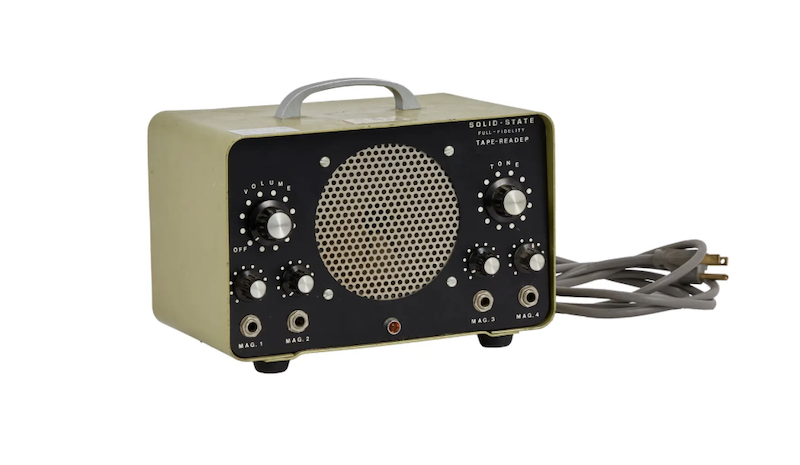
There’s an auction for personal items from the life and work of the late filmmaker David Lynch. I’m relieved to not harbor much of an attachment to objects that are accompanied by what Walter Benjamin might have described as the aura of previous ownership — all the more so given the apparent uptick in price such an aura can incur.

However, given Lynch’s extended interest both in sound and in music-making, I was intrigued by what may be for sale, so I scrolled through the auction listings. In addition to lots of guitars (including a four-in-one combo) and guitar pedals, and even a Stylophone and a hybrid Indian instrument called a Swar Sangam, a few things did stand out:

A solid-state Moviola 1027C Tape Reader:

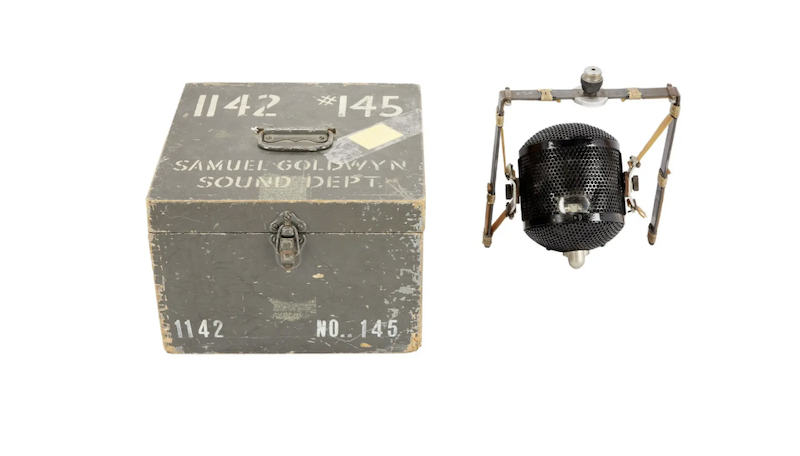
A 1930s Western Electric RA-1142 transmitter ribbon microphone, in a quite awesome sound department case:

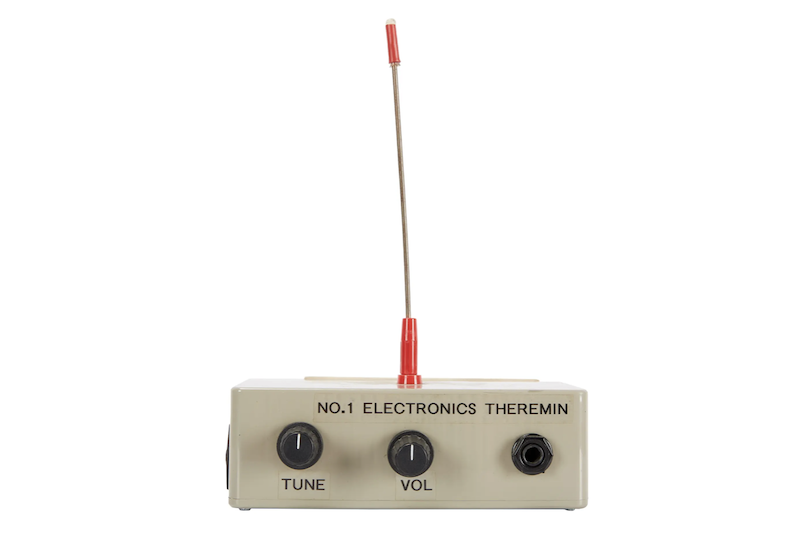
A Theremin by Tony Bassett of No.1 Electronics. Note the “Space Trip Passport” on the rear further below:

The auction begins June 18, 2025, at 10am Pacific Time in Los Angeles at juliensauctions.com.

Lost in the Clouds

r beny is back

It’s been nearly three years since the excellent synthesizer musician r beny posted a video on his YouTube channel, and he returned on June 9 with an exploration of a specific approach, using a popular module to simulate low-fidelity tape delay. The result is the slowly decaying sound of what originates as a clearly plucked instrument. The plucking remains for a while, but it is eventually all but smothered by its processed aftermath. More from beny at Instagram and Bandcamp. Oh, and there’s no talking in the video. He just plays.

The Tragedy of Home Audio

In the age of streaming

I spent a chunk of Sunday afternoon getting my old, secondhand Mac mini that I employ as a central home jukebox running properly again.

The computer hadn’t stopped working, per se. I could still listen to the music files on it remotely — both at home and away from home — on my phone, laptop, and iPad. I could — when at home — add to the computer’s hard drive new music files from albums I’ve purchased or received advance copies of from musicians, record labels, and publicists. I could also play the tracks at home from the living room television, because the software I use to keep track of my ever-growing digital library/archive/collection has an app that appears as part of the television’s interface.

However, two things had stopped working in this somewhat fragile system:

First of all, the Mac mini’s physical audio jack was no longer sending music to the living room amplifier, which is, in turn, connected to a proper pair of speakers, which sound better than the television’s speakers.

Second of all, the secondary software service that I use to keep the library of music files backed up in the cloud had stopped working.

The existence of these two issues was ironic, because I had spent lunch the week prior with an old friend providing some advice to him about how to manage the modern hassle that is maintaining a personal audio library of digital files.

By the end of Sunday afternoon, one of those two problems had been fixed, the first of them. I made an attempt at sorting out the second issue, the cloud one, and my efforts didn’t appear to do the trick, so I’ll try again soon.

I run my Mac Mini “headless,” which means without a screen. It sits on a shelf below the television alongside the amplifier and record player and CD player, etc., just a modestly proportioned aluminum box with some cables coming out of it, including those connecting to small external hard drives.

When I do need to access the Mac to actually use it as a computer, which is infrequently, the process is a minor hassle.

First, I have to attach a small wired keyboard and a small wired mouse that connect via USB.

Second, I have to hook up my iPad to serve as a screen. An iPad can’t serve directly as a screen, and the software options for doing so are better when the iPad is serving as a secondary screen, not a primary one. To use the iPad as the sole screen for the Mini, I employ an app along with a special dongle called a “video capture card,” which attaches to the iPad via USB, and then connects to the HDMI cable coming out of the computer.

Now, the first rule of tech support is to make sure your software is up to date, and neither the Mini’s operating system nor the music library software was, which seemed odd, since I was pretty sure I had set both to update automatically. I took care of these updates immediately.

The second rule of tech support is to reboot the computer, which I did as well.

After I did steps one and two, the playback-through-audio-jack issue had been solved. The backup issue remains. And there are two additional things I want to sort out: (1) how to add files to the Mac Mini when I’m not at home, and (2) how to remotely access the full Mac Mini at home with my laptop (that’s in contrast with merely dragging files to it over the wifi network), so I don’t have to do the whole iPad/dongle routine each time I need to actually do something to the machine beyond filling up its drives.

I haven’t yet mentioned the specific software I use, because the situation is fairly generic and lots of tools do the trick. For the record, I use Plex (plex.tv) as the server and Backblaze (backblaze.com) for backup, and on the iPad I use an app simply called “HDMI” (apps.apple.com) to serve as a second screen. I have experimented with Tailscale (tailscale.com) for the remote access I mentioned, but haven’t managed to get it to work.

The moral of this story is that the music industry remains broken. While it’s the case that streaming causes lots of financial and cultural damage, the alternative scenario has its own shortcomings, which have nothing to do with streaming. The main opposite of streaming music is to own your own digital files of music you have purchased. However, there are no simple means by which everyday listeners can take the files they’ve acquired, and play them back with the ease that used to be the case with LPs and cassettes and CDs and so on. There was a brief period of time when iTunes did the job, but the era of iTunes has long since passed.

I remain hopeful that someone will try to do something to answer this ongoing problem. None of the existing solutions do so sufficiently, except perhaps for those of us who are willing to give over our Sunday afternoons to trying to fix something and who will be satisfied when only half the fixing has been completed. Listening to music shouldn’t be reserved for tinkerers.

Update: All the sub-items on the to-do list mentioned in this article have, as of June 15, 2025, been taken care of. Plex (www.plex.tv) runs as a server on a Mac mini at home. The Plexamp app — on my phone, tablet, and laptop — lets me access the audio from anywhere, including in the car (via Apple’s CarPlay). I can tweak stuff on the Mac mini while at home via Screen Sharing (see: apple.com), an Apple app. When not at home, I can now transfer files to the MacMini using a secure network (there are several options I explored, including Tailscale and ZeroTier, and I’ll likely go into further detail on those down the road).