Disquiet Junto Project 0598: Mixmaster Mic

The Assignment: Record the same sound with multiple mics; mix the results.

Each Thursday in the Disquiet Junto music community, a new compositional challenge is set before the group’s members, who then have just over four days to upload a track in response to the assignment. Membership in the Junto is open: just join and participate. (A SoundCloud account is helpful but not required.) There’s no pressure to do every project. It’s weekly so that you know it’s there, every Thursday through Monday, when you have the time and interest.

Deadline: This project’s deadline is the end of the day Monday, June 19, 2023, at 11:59pm (that is, just before midnight) wherever you are. It was posted on Thursday, June 15, 2023.

Tracks are added to the SoundCloud playlist for the duration of the project. Additional (non-SoundCloud) tracks appear in the lllllll.co discussion thread.

These following instructions went out to the group’s email list (at tinyletter.com/disquiet-junto).

Disquiet Junto Project 0598: Mixmaster Mic
The Assignment: Record the same sound with multiple mics; mix the results.

Step 1: This project will require some preparation. You’re going to need a few different microphones, so consider what’s available — not just a standard mic, but your phone, laptop, maybe even a domestic surveillance device, etc. Maybe you can borrow a few mics from friends.

Step 2: Record a single sound source — an acoustic or electric instrument, a field recording — using all those microphones assembled in Step 1. Optimally you can set everything up and record simultaneously once. Or you can do so in batches — or one at a time. If not recording with all the mics at once, try to re-produce the same source sound each time through, as closely as possible, so the recordings will more or less match up.

Step 3: Make a piece of music that involves switching between and combining all the microphone recordings you made in Step 2. Light processing is allowed.

Eight Important Steps When Your Track Is Done:

Step 1: Include “disquiet0598” (no spaces or quotation marks) in the name of your tracks.

Step 2: If your audio-hosting platform allows for tags, be sure to also include the project tag “disquiet0598” (no spaces or quotation marks). If you’re posting on SoundCloud in particular, this is essential to subsequent location of tracks for the creation of a project playlist.

Step 3: Upload your tracks. It is helpful but not essential that you use SoundCloud to host your tracks.

Step 4: Post your track in the following discussion thread at llllllll.co:

https://llllllll.co/t/disquiet-junto-project-0598-mixmaster-mic/

Step 5: Annotate your track with a brief explanation of your approach and process.

Step 6: If posting on social media, please consider using the hashtag #DisquietJunto so fellow participants are more likely to locate your communication.

Step 7: Then listen to and comment on tracks uploaded by your fellow Disquiet Junto participants.

Step 8: Also join in the discussion on the Disquiet Junto Slack. Send your email address to [email protected] for Slack inclusion.

Note: Please post one track for this weekly Junto project. If you choose to post more than one, and do so on SoundCloud, please let me know which you’d like added to the playlist. Thanks.

Additional Details:

Length: The length is up to you.  

Deadline: This project’s deadline is the end of the day Monday, June 19, 2023, at 11:59pm (that is, just before midnight) wherever you are. It was posted on Thursday, June 15, 2023.

Upload: When participating in this project, be sure to include a description of your process in planning, composing, and recording it. This description is an essential element of the communicative process inherent in the Disquiet Junto. Photos, video, and lists of equipment are always appreciated.

Download: It is always best to set your track as downloadable and allowing for attributed remixing (i.e., a Creative Commons license permitting non-commercial sharing with attribution, allowing for derivatives).

For context, when posting the track online, please be sure to include this following information:

More on this 598th weekly Disquiet Junto project, Mixmaster Mic (The Assignment: Record the same sound with multiple mics; mix the results), at: https://disquiet.com/0598/

The image to the “cover” of this project is from an 1880 U.S. patent.

About the Disquiet Junto: https://disquiet.com/junto/

Subscribe to project announcements: https://tinyletter.com/disquiet-junto/

Project discussion takes place on llllllll.co: https://llllllll.co/t/disquiet-junto-project-0598-mixmaster-mic/

30s

A little Instagram project

I’m on an initial work-free summer vacation break at the moment, hence my limited activity on social media, and the lack of a This Week in Sound email newsletter issue yesterday and this evening. I’ll be back at it by next week, and I may have a newsletter issue out on Friday. Tomorrow will mark the 598th consecutive weekly Disquiet Junto project. I have a new record review due out shortly at Pitchfork, and there’s a new book review I’m working on for The Wire, and some essays in progress for some other places — plus longer form writing I’m blocking out time for this summer. (I should probably mention here: If you’re reading this and you edit a publication that might be interested in me writing for it, lemme know.)

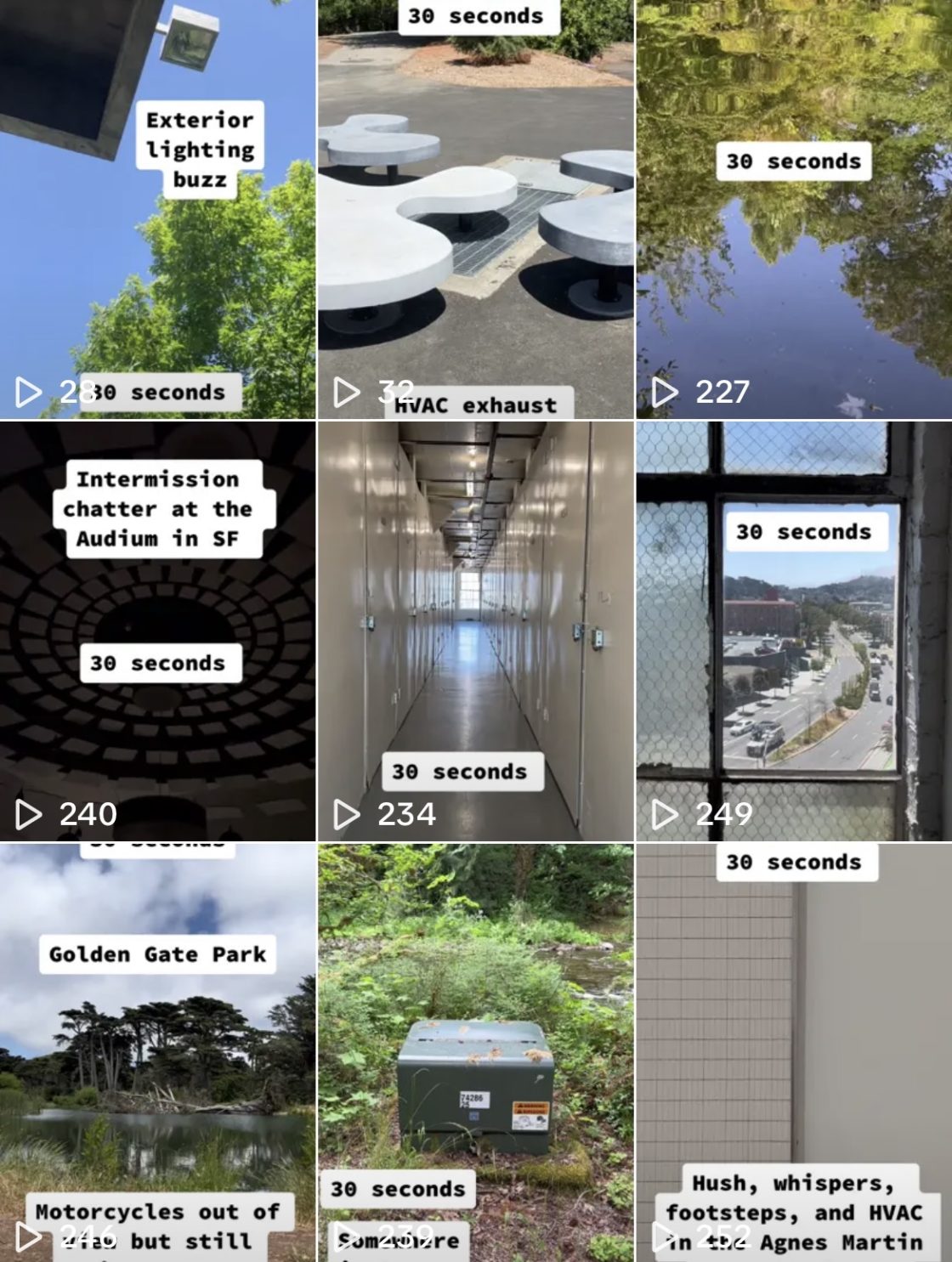
In the meanwhile, if you’re on Instagram, I’ve begun a series of 30-second audio-video field recordings. They’re “stories” (not “reels” — a distinction that still somewhat eludes me), and they’re grouped as a “highlight” section that I’ve titled “30s” — and if that’s not enough information, welcome to the modern internet. This is all at instagram.com/dsqt. I’m trying to sort out if there are other/better ways to post such short vertical videos (maybe YouTube, maybe Vimeo?). They’re inspired by the great ongoing occasional slice-of-life recordings that Jorge Colombo, an old friend of mine, has been posting on his account. Jorge is a far better photographer, visual thinker, and observer than I am. His work is quite incredible.

I’m really interested in the combination of audio and visual elements in field recordings, and how mundane moments can, when framed carefully, have a heightened quality. And I’m even more interested in how during the 30 seconds I am recording, I pay incredibly close attention to what I’m hearing (and to a degree what I’m seeing). It’s as if hitting record doesn’t just trigger my phone’s camera; it also engages my attention.

Sound Studies x Theology

My review of Kim Haines-Eitzen's Sonorous Desert: What Deep Listening Taught Early Christian Monks – And What It Can Teach Us

This book review I wrote originally appeared in the May 2023 issue of The Wire, number 471. The article appears here (from behind the paywall, now that subsequent issues have come out) in ever so slightly edited form (just matters of punctuation). As I noted at the time of its publication: major thanks to my old friend Erik Davis for having tipped me off to this.

Here’s the review in full:

Sonorous Desert: What Deep Listening Taught Early Christian Monks – And What It Can Teach Us 
Kim Haines-Eitzen 
Princeton University Press Hbk 145 pp 

For Kim Haines-Eitzen, the desert is both biblical and personal. An American, she spent her childhood in the Middle East, or Near East, reared by parents who, inspired by their Mennonite heritage, had moved from the US to Jordan to study Arabic and do humanitarian work. Born in the late 1960s, she associates her experience with serenity and fear alike, with the quiet expanse of the Sinai and the sirens of the 1973 Yom Kippur war. The shore of the Red Sea was her holiday playground.

Now a Cornell University professor of religion, Haines-Eitzen seeks to merge the personal and the biblical in a slim volume with a vaguely self-help-ish subtitle, Sonorous Desert: What Deep Listening Taught Early Christian Monks – And What It Can Teach Us. She achieves this goal through the humble act of sitting quietly, much like the hermits of yore.

Unlike those hermits, however, she has audio recording gear in tow. Since 2012, Haines-Eitzen has documented the sound of the places she visits and where she lives. The poetic codas to each chapter feature QR codes that, given the context, can be mistaken for the ornate initials that decorated ancient manuscripts. These link to online recordings she made around the world. Her tracks transport the listener to places like her family’s retreat in Arizona and the canyons of the Wadi Qelt in the Judean Desert.

The key word is retreat. Despite the monastic act’s association with solitude, a monastery is itself a community, and thus the notion of self-exile gets revealed here as something more akin to migration: from one life to another, from exterior to interior. In Haines-Eitzen’s telling, such paradoxes inherent in the monastic impulse run deep. While Trappists take vows of silence, most monastic life is simply remote. Less explored in the book is the contrast (even conflict?) between personal discovery and selfless divinity.

The narrative moves back and forth between the wired present and the mythic past. In meaningful ways, little has changed, least of all the human propensity to complain about noise pollution. An early avatar of this disgruntlement is Antony, a celebrated hermit from roughly 1800 years ago who “left the noise and distractions of city life for the quiet of the desert.”

We abandon civilization alongside Antony, and with other monastic aspirants. The ancient ones include the saints John Climacus, Paul, George of Choziba, and Eucherius, who said “no sound is heard in the desert save the voice of God.” Haines-Eitzen politely disagrees: the desert is rich with sound. We witness her personal revelations (sometimes repetitively) in this regard, such as the idea that to listen while recording is to listen intently, and to re-listen through the ears of the machine is to hear what one might not have otherwise. Likewise, she stops trying to capture the world “pure and pristine,” without people in it, and comes to appreciate humans’ sonic place in the environment. We also visit reverberant cave chapels, ponder the animism belied by Western monotheism, and learn lots of cool ancient Greek onomatopoeia.

Sonorous Desert is a book about seekers, among them the widely travelled author herself. Modern figures cited include Edward Abbey, Virginia Woolf, Gordon Hempton and Thomas Merton, each arriving at the same conclusion: the quest for external silence is ultimately one for internal peace. (Oddly, that list doesn’t include Pauline Oliveros, who is synonymous with the deep listening mentioned in the book’s subtitle.) Wandering into the desert provides a metaphor for the effort and time required. As Haines-Eitzen quotes Merton from 1962, foreseeing smartphone apps like Calm and Headspace half a century hence, “You can’t have interior silence just by pushing a button.”