Milton Babbitt Remix MP3

Up at the website of Bad Plus pianist Ethan Iverson (well, mostly Iverson, with the other members occasionally joining in — thebadplus.typepad.com): a sort of remix of work by 20th-century classical composer Milton Babbitt.

It’s just over a minute long, but Iverson has taken the jazzy inflections of Babbitt’s 12-tone original, “Semi-Simple Variations,” heard here with Monk-ish drums added in a live performance by fellow Plus member Dave King, with some subsequent editing in the audio program Peak to clean it up (MP3). Iverson describes the process:

After hearing me practice “Semi-Simple Variations” a few times on tour, Dave suggested playing some drums along at the soundcheck in Odense, Denmark. It actually sounded really good!

I … then threw it into Peak and added compression and harmonic rotation. The result sounds a bit like twelve-tone Aphex Twin (of course, Aphex’s tones would be vastly superior).

The complete post is at thebadplus.typepad.com. Iverson’s post is a lengthy program note to a concert he’s put together for this coming October 30 with New Yorker music critic Alex Ross — part pre-Halloween bash, part celebration of Ross’s recent book, The Rest Is Noise: Listening to the Twentieth Century.

The fact of a jazzy, electronically mediated rendition of a piece of fairly hardcore serialism is exciting, certainly. (It doesn’t hurt that it follows quickly on critic Anthony Tommasini’s helpful overview of the state of serialism in the New York Times, at nytimes.com.) But even more exciting is the expansion of the idea of a remix: the MP3’s basis in an original, impromptu recording; the use of software to warp a proper performance. (Via Ross’s therestisnoise.com.)
Daniel Catarino’s Western MP3s

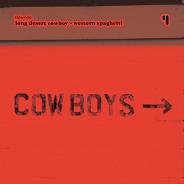
The netlabel album Western Spaghetti by Long Desert Cowboy (aka Portugal-based Daniel Catarino) opens with a slow fumbling of earthly rumble before backtracking to something more spare, intimate — less “western,” perhaps, than “horror-show”: all jangly noise in a closed space, footsteps nearby and church-like bells in the distance. That piece, the album’s longest, extends through 10-plus minutes and at least two more set pieces, before closing on conciliatory tones that take a last minute turn toward tension, a coda that brings the horror back to the surface (MP3).

The album’s four other tracks explore likewise filmic soundscapes that feel ascetic and forlorn. The other main keeper is the closing entry, the most uplifting here despite its title (“Tired of Being Fucking Poor and Honest”); it loops bells even more realistic than those in “For the Money,” for a dreamy, enticing montage (MP3). More info at the website of test tube, the releasing netlabel: monocromatica.com.

Final Microbio Netlabel MP3

All minuscule little noises that blip along like a dusty windup toy on its last legs, the opening track on Yopoman‘s Autonomatismos Parcelarios (MP3) was one of the last things to be heard from an excellent netlabel before it went silent in late 2006. That label was microbio (microbiorecords.net), and while it’s survived by several domain-sharing services, including the equally estimable biodata netlabel (biodata.microbiorecords.net), it’s still missed. That MP3 appeared on the freely downloadable album along with two others, a nearly half hour live cut that gurgles like a half-organic machine until it tragically runs out of steam (MP3) and a glitchy whorl of dubby echo (MP3). Any word on what Yopoman (born Emiliano Hernandez-Santana) has been up to subsequently would be appreciated.

Site Upgrade Update

This site was upgraded expertly by Nathan Swartz of clicknathan.com from my decade-old handcoded HTML to a proper WordPress install on July 26, 2007. Left lingering for me to take care of was a relatively small proportion of back articles, mostly from the “interviews” and “reports/essays” sections.

I just today uploaded four more of the backdated interviews: Raz Mesinai‘s work beyond dub, Kenneth Kirschner‘s algorithmic layers, Thomas Dimuzio‘s crashing by design, and Christopher Bissonnette‘s willfully peripheral ambience.

In the “reports/essays” section header, I added a list of the past entries yet to be uploaded.

The “elsewhere” links section of the site is no longer in beta; all the old links have been added, and it’s being updated regularly (with ease, thanks to the implementation of del.icio.us support).

And the site’s RSS feed, which is supported by feedburner.com, now displays the appropriate header link for each entry (they used to appear as “feedburner.com/etc.,” but now appear as “disquiet.com/etc.”).

Just housecleaning.

Disquiet’s San Francisco Events Calendar

Though the musical agenda of this website, Disquiet.com, is in no way limited by geography, the fact of the matter is that I live in San Francisco, California. And since that’s where my body generally is, it’s often where my head is — and where much of my listening is.

When I travel, I try to take notes, whether in Chicago, Tokyo, Los Angeles or New York City. But most of my time is spent in San Francisco, a city particularly rich in ambient/electronic and general sound-art happenings. For a year or so now I’ve maintained a public calendar available via the excellent Google Calendar service. The calendar served initially just as a way for me to keep track of upcoming events I might wanna check out, but friends expressed interest, so I made it public; thanks to Google’s excellent user interface, this required, all told, approximately one minute of effort on my part.

 If such a calendar sounds of interest and you use any iCal-supporting calendar service, subscribe here.

 If you just want the RSS/XML feed for your feedreader, subscribe here.

 If none of that Internet gibberish above means anything to you, or you just wanna view the calendar as a web page, click here.

This is the calendar’s description in Google:

SF ambient/electronic events

San Francisco Bay Area events in the vaguely defined realm of ambient/electronic music/performance and sound art, compiled as a side project of Disquiet.com. At least initially, the calendar is both broad (i.e., also includes some underground hip-hop, which is of course studio-constructed, and contemporary classical, which is often minimalist and/or electronically enabled) and focused (i.e., only includes events I specifically plan on potentially attending).

The one thing that Google Calendar doesn’t seem to easily allow for is listing ongoing events, such as gallery and museum exhibits — if anyone out there has a suggestion about how to manage such a thing, please let me know. Thanks.

By the way, there are far better and more thorough calendars for such musical goings-on in the greater San Francisco Bay area, most notably at bayimproviser.com.

And here on the Disquiet.com website’s Elsewhere links page there is a small but growing catalog of events-listing services for various cities — web services that emphasize the sort of music covered here.