Reviewed “Seeing Sound” @ Kadist SF

For The Wire

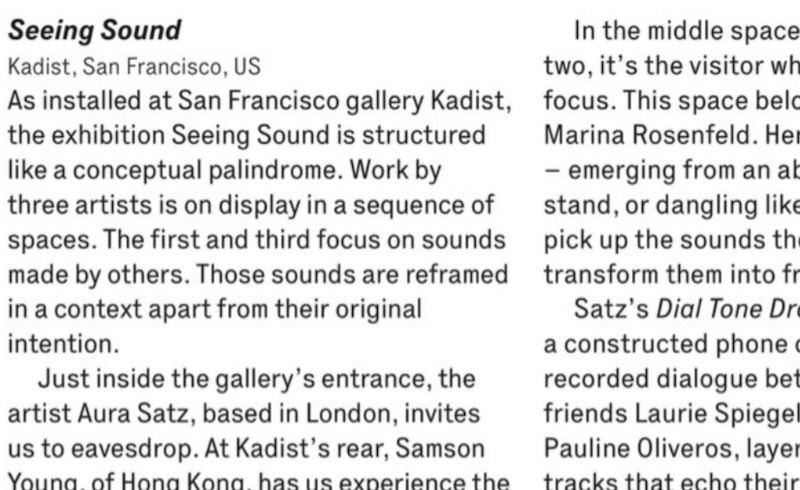
Ah, it’s that font I love to be published in. I have a new article in the latest issue of The Wire. It’s a review of a group show at the Kadist gallery in San Francisco. The show, titled Seeing Sound, featured work by the artists Marina Rosenfeld, Aura Satz, and Samson Young, and was curated by Barbara London. (This is the new issue with Grouper on the cover.) I posted a bit about the exhibit here previously.

When the Doorbell Tolls for Itself

A domestic requiem

You don’t miss you water ’til your well’s run dry, and you don’t miss your doorbell until it’s no longer capable of being rung. But before the doorbell gets to such a state, there is, apparently, a death rattle, as I’ve now learned firsthand.

In the case of the doorbell in the home where I have lived for nearly 13 years, this rattle took the form initially of a long held note, and a dense one at that — not so much handfuls as bushels of overtones. The doorbell was rung one recent afternoon, and many seconds passed before I realized it wasn’t receding. It wasn’t quieting. It rang, and then it held, like a violin played with an endlessly long bow — or to borrow a term from synthesizers, as if some tiny, granular segment of it had been captured and then looped so as to give the illusion of an extended pause. I was caught within a frozen, eternal moment of doorbell-ness. Part of me didn’t want it to ever end. Part of me feared it never would. Part of me knew this was the end, or close to it. This was the sound of a doorbell when it tolls for itself.

I woke from the spell when I recognized that while the doorbell may be on a kind of held pause, whoever had cause it to ring was outside the time-loop bubble, or at least outside the front gate. I opened the door to receive the inevitable package, and then headed back upstairs. There, at the end of the hall, above the entrance to the kitchen, the doorbell continued to ring. It was such a strange presence, this all too familiar sound — even when I knew someone was due by for a visit, it would shock me and send the hair of my arms up on end — heard in a new way.

As it played on, and on, my sense was this was no mere blip. This was the end. It was the end, but it just wasn’t over yet. The ringing was orchestral. It felt like it can be to watch ocean waves churn over and over: in constant motion, yet in many ways never really changing, and all along giving only a hint of the depths they cover.

And then the drone of this former bell, the held tone of this former terse chime, began to settle, like a balloon deflating, like ice melting, so slowly that there came a point when I couldn’t tell if it was still ringing, or if I was just remembering the impression of its ring.

And then briefly it surfaced again, fading in, rising to a substantial volume, though with none of the strength it had moments before, only to fade out with an unambiguous finality. This fade was the end. There was a memory, but there was no illusion of presence. No pressing of the buzzer outside could revive it.

When someone rings it currently, if the house is quiet, there is a distant buzz. There is, of course, no ring. A replacement needs to be selected, and installed, but there’s time for that. Replacing it too soon feels a bit like replacing a recently deceased pet. A respectful void is necessary before one truly moves on. For now there’s near silence, and I could get used to it, impractical as it may be.

“Loner” Versus/Plus “Joiner”

Thanks to Peggy Nelson for the hilobrow.com interview opportunity

Leave it to ever insightful Peggy Nelson, aka Otolythe various places online, to point out something about the Disquiet Junto that had never occurred to me previously. In a tweet linking to an interview she did with me on the occasion of the 500th consecutive weekly Junto project, she noted the countervailing origins of the music community. There is, of course, on the one hand Fernando Pessoa, author of *The Book of Disquiet*, and on the other Benjamin Franklin, who in 1727 founded the Junto in 1727 from which ours takes its name. Nelson in her tweet referred to the “dual, and dueling, presences of the ultimate loner (Fernando Pessoa) and the ultimate joiner (Benjamin Franklin).” I love this so much. It’s loner versus/plus joiner. So true! Thanks!

The full interview is at [hilobrow.com](https://www.hilobrow.com/2021/08/05/eye-candy-49/). I want to reproduce one of the Q&A items here:

>Nelson: Do you think, overall, the Disquiet Junto is more Pessoa-inflected, or Franklin-inflected, in how it has played out? (I am imagining the Franklin influence to be the discussions/comments.) Or are you satisfied that it’s been a pretty even balance?
>
>Me: That’s a wonderful question. Thank you for it. I think the Disquiet Junto is fairly evenly divided between the influence of Fernando Pessoa and the influence of Benjamin Franklin. I should note that, by and large, it’s quite easy to participate in the weekly music composition prompts without being aware of where either word, Disquiet (from Pessoa’s *The Book of Disquiet*) or Junto (from Franklin’s 1727 private society of that name), originated.
>
>The “mutual self-improvement” aspect of Franklin’s original Junto provides a solid foundation for our group, and it’s a key part of why many people join in. Franklin was an instinctive creator of communities, small and large, from clubs to libraries to fire departments to schools to the United States of America. Our Junto is, in effect, his creation, as well. The Junto is very Pessoa in part because of certain aesthetic predilections inherent in the weekly music composition prompts: A lot of the musical prompts are about everyday sounds, everyday experiences, philosophical observations, then transformed into something artistic through reflection and consideration. In addition, an enormous percentage of Pessoa’s output was never completed. The Book of Disquiet itself is a collection of many scraps, of pieces of rough drafts. A big part of the Junto ethos is about posting unfinished work, works-in-progress, and I think that is very Pessoa.
>
>However, there is one aspect of Pessoa I would like to see become more generally accepted. I think the Pessoa mode would be one in which individuals read a prompt and don’t ask, “Does this appeal to me?” but instead put the “me” aside and allow that doing something apart from “me” can be not just a beneficial experience, but an essential one. To borrow a phrase from another poet, Walt Whitman, it’s evident that Pessoa contained multitudes. I think it’s healthy to embrace one’s inner multitudes, or at least one’s inner many, even one’s inner handful. I think a lot of participants do that already, certainly, but I don’t think I’ve done a good enough job of emphasizing the benefits for people of doing projects that don’t seem, on first glance, as applicable to them as individuals. Doing so requires me to strike a difficult balance as a moderator, because I don’t want the Junto to be a source of stress. I don’t want anyone to fear they’re missing out by skipping any project or set of projects. The overall design and structure of the Junto is that it’s there when participants have the time and interest, week in, week out. I would like the Junto to be a little more Pessoa as we proceed, in this sense of it, in people trying things precisely because, as a member might say, “it doesn’t feel like me.”

CBC Radio on the Disquiet Junto

A segment from last week

Major thanks to Lee Rosevere of CBC Radio St. John’s, I had the opportunity to talk with him last week about the Disquiet Junto music community on the occasion of its 500th consecutive weekly project. The segment is now archived online, having played on several CBC stations. Lee is both a producer at the CBC and a longtime Junto participant. The recorded conversation is just shy of 10 minutes long. (That’s not me in the photo. That’s the radio show’s host.) Listen at [cbc.ca](https://www.cbc.ca/listen/live-radio/1-130-mainstreet-pei/clip/15859116-disquiet-junto?fbclid=IwAR2g6yw3uqUKBZ-YcItlVbWYTCBKKivM9z_Fci9QMyWAvj-13tW6IJaVGAg).

twitter.com/disquiet: Bandcamp, Pessoa, Vangelis

From the past week

I do this manually each Saturday, collating recent tweets I made at twitter.com/disquiet, which I think of as my public notebook. Some [tweets](https://disquiet.com/2021/08/06/night-after-night/) pop [up](https://disquiet.com/2021/08/04/sawtooth-waves-irl/) in [expanded form](https://disquiet.com/2021/08/03/rhythm-approaches-publishing-and-unlike-minds/) or otherwise) on Disquiet.com sooner. It’s personally informative to revisit the previous week of thinking out loud.

▰ It remains the case that Facebook is where I learn how little I have in common with my friends and Twitter is where I learn how much I have in common with people I don’t know.

▰ Say what one might about the decline of brick and mortar record stores, it was nice to [buy records on Bandcamp Day](https://bandcamp.com/disquiet) before I finished my coffee. Heck, before I was outta my pajamas. Then again, I’ve worn pajamas pretty much non-stop since March 2020, but you know what I mean.

▰ I’m reading Richard Zenith’s Fernando Pessoa biography. I will be for some time, as it’s over 1,000 pages long. A key theme: how Pessoa’s employment of multiple, named, distinct voices (“heteronyms” in his trenchant terminology) offers a glimpse into the psychology of modernity. It’s an underlying concept for the recent Disquiet Junto music community project, our 500th consecutive weekly one, in which participants play the same tune three times: once as themselves, then under two fictional identities.

▰ Reward is a great reinforcement of good habits, and so it is that when I post the Disquiet Junto early enough (California time) on a Thursday, there are usually enough tracks for me to start the playlist rolling before dinner. This week, [Thursday](/0501) was such a day.

▰ This week in the Disquiet Junto music community, participants record the sounds of an alien landscape as inspired by Philip K. Dick’s short story “We Can Remember It for You Wholesale.”

tl;dr

▰ Come for the Vangelis meme, stay for the sort of drama that even a sports-disinterested person such as myself can’t help but be astonished by. Sifan Hassan is [an inspiration](https://twitter.com/JessieOnTheEdge/status/1422031657511567361).

▰ Just noting that the new Los Lobos album, [*Native Sons*](https://loslobos.bandcamp.com/), is absolutely killer, further evidence, as if any were needed, that the band is a national treasure. Native Sons is a love letter to the great city of Los Angeles. Slightly off-topic for this website, but so be it. Great is great.

▰ Another week over. My birthday apparently occurred at some point. Taking next week off. My Twittering may diminish, too.

🗹 workin’
🗹 longform writin’
🗹 bonus longform writin’
🗹 Junto 501
🗹 guitar: triads triads triads
🗹 exercise
☐ email catch-up
🗹 sign off until Monday