Developing “Intense”

A track by Jeannine Schulz of Hamburg, Germany

Unlike a lot of music labeled “ambient” on SoundCloud, the track “Intense” from Jeannine Schulz is a fully realized composition. It’s neither a sketch nor a deep dive into an extended stasis. It has atmosphere certainly, but also shape, and development, and internal tension. There’s pockmark percussion that echoes like a troubling memory, and also what seems to be a guitar line, one comfortable with its own reduced pace. Another guitar line, a bass-like presence, gathers force later on, while at the other end of the spectrum, twirls of high-register vapors circulate with a gentility that belies their speed. It’s a great piece.

Track originally posted at [soundcloud.com/jeannineschulz](https://soundcloud.com/jeannineschulz/intense). More from Schulz, who is based in Hamburg, Germany, at [jeannineschulz.bandcamp.com](https://jeannineschulz.bandcamp.com/).
Old Tape + New Tech

In the work of Takeyuki Hakozaki

The combination of archaic reel-to-reel tape and contemporary synthesizers is a not uncommon one, especially on synth YouTube, where “composition” sometimes means visual components as much as it does sonic ones. The bond between such elements as these two isn’t entirely a matter of chance, or even of individual predilections. The design of contemporary synthesizers such as the modules depicted here often embraces the tactile and the eccentric, both qualities shared by the old tape technology. Furthermore, the give and take of tape, especially when looped and loosely slung as in this short piece by Takeyuki Hakozaki, provides a contrast to the voltage-controlled systematization offered by synthesizers. In Hakozaki’s piece, a melody is pinched and pulled from a cycle of squelchy tones, while an bed of bubbly percussion keeps things roiling.

This is the latest video I’ve added to [my YouTube playlist of recommended fine live performances of ambient music](https://www.youtube.com/playlist?list=PLAgCxRbmR1MJxihgJkCPEnehAPvjoF71-). Video originally posted at Takeyuki Hakozaki’s [YouTube channel](https://www.youtube.com/watch?v=Zq0aP3JIbh0). More from Hakozaki at [instagram.com/t.hakozaki](https://www.instagram.com/t.hakozaki/).

Current Listens: Fullman + Tenet + Funki Porcini

Heavy rotation, lightly annotated

This is my weekly(ish) answer to the question “What have you been listening to lately?” It’s lightly annotated because I don’t like re-posting material without providing some context. In the interest of conversation, let me know what you’re listening to in the comments below. Just please don’t promote your own work (or that of your label/client). This isn’t the right venue. (Just use email.)

▰ ▰ ▰ ▰ ▰ ▰ ▰ ▰ ▰ ▰ ▰ ▰ ▰ ▰ ▰

NEW: Recent(ish) arrivals and pre-releases

Best known for her Long String Instrument, Ellen Fullman is heard in late-1980s musique-concrète mode on *Music for the Man Who Grew Common in Wisdom*, due out October 16 from the Besom Presse label, based in Los Angeles. One track is already available for streaming. Listen as a stereo recording of lapping water lapses into a rhythmic pulse.

The director of the new thriller *Tenet*, Christopher Nolan, may prefer we see it in theaters, but at least its score is online, courtesy of the record label WaterTower Music, for those of us maintaining significant social distance. Music by composer Ludwig Göransson.

Funki Porcini is a favorite from way back at the dawn of electronica, and his latest does not disappoint. *Motorway* opens with cinematic beats before proceeding through a mix of lush ambience imbued with a sense of intimacy, surveillance, and drama.

A Variety of Elevations

An ongoing series cross-posted from instagram.com/dsqt

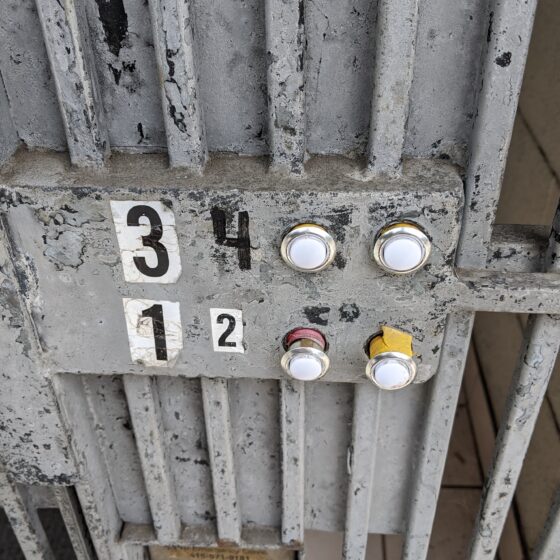
By definition, a doorbell is a three-dimensional object, four dimensions if you count the sound of that bell ringing as it is experienced over time. To press a doorbell is to push, to exert some amount of pressure — to, in effect, prematurely enter the premises, if only by a millimeter or two. Still, in most cases, a doorbell presents an effectively flat visage, two dimensions, generally white and circular. Even as time passes and the doorbell falls — almost inevitably, at least in urban settings — into disrepair, that flatness is its natural mechanical state. But sometimes the third dimension has a means of making itself felt. Putting aside the readymade punk-rock-flyer quality of the dwellings’ numbers, the buttons on this doorbell are situated at a variety of elevations. This is due to damage over time and subsequent attempts to address the damage, not some sort of experimental next-level user-interface design. Apartments 1 and 2 are truly distended, the color-coded red and yellow tape seemingly providing some sort of support to the mechanisms. (The yellow appears to be consistent with the makeup of the two buttons on the top row, suggesting the red tape is an after-market DIY fix-it attempt.) Even apartment 4 is further out than the baseline depth provided by apartment 3. I usually shoot doorbells straight on, but this one required an angle and some elevation to be faithfully represented.

Quantum Violin

From the pairing of Mia Zabelka and Glen Hall

If the sounds of Quantum Violin enacted by Mia Zabelka and Glen Hall are remarkable — dense miasma from which undulate denser waves and through which eventually pulses a vibrant heart — so too are the means by which they were accomplished:

> Quantum Violin has a sub-structure formed by sounds generated by a Quantum Oscillator that are audible throughout the piece. It was programmed with 8 different sets of parameters, giving the ‘drone’ a slowly varying texture. This sub-structure was created to signify physical reality’s undergirding in the quantum realm, a constant vibrational ‘hum’. Two tracks of Mia Zabelka’s violin were given 3 ‘treatments’ within this sonic landscape. Two treatments were done by IRCAM’s artificial intelligence software, OMax, which segmented and recombined the violin’s performances to coincide with movements in the video, which forms the visual aspect of the quantum world: geometric and vibrating. The third treatment was to atomise the violin’s sound into the microsound sphere using IRCAM’s CataRT, that segmented it into sonic ‘quanta’, tiny grains 0.071 milliseconds, to produce minute clicks, representing the smallest sonic events possible, while still remaining audible. Mia Zabelka’s violin exists as the centre of a quantum sound galaxy.

Track originally posted at [soundcloud.com/miazabelkamusic](https://soundcloud.com/miazabelkamusic/quantum-violin-mia-zabelka-glen-hall-1). More from Zalbelka, who hails from Austria, at [miazabelka.com](https://www.miazabelka.com/).