

Full playlist at [youtube.com/disquiet](https://www.youtube.com/playlist?list=PLAgCxRbmR1MIM4mCYe17nERi9xeEWAD2w).
Full playlist at [youtube.com/disquiet](https://www.youtube.com/playlist?list=PLAgCxRbmR1MIM4mCYe17nERi9xeEWAD2w).
One Buddha Machine, the Philip Glass edition, playing the organ loop, three processed channels of which go into the mixer. When the piece begins, it’s just the signal going through the granular synthesizer (channel two). Then comes the main line (channel one), which is the output of the Muxlicer. There are eight randomly selected outputs from the Muxlicer: six bands of the filter bank, and two of the granular synth, all set at different volume levels. They’re being selected at random, and the clock that sets the pace of the Muxlicer changes regularly. The basic pulse is a square wave from the Dixie II. There’s a hybrid wave from the Batumi, via the SPO, that occasionally makes the Dixie II pick up the pace, as a result of two different combined waves. The third channel of the mixer is a copy of the audio in the second channel, that of the granular synth processing the inbound signal, except it’s going through the ER-301 and being delayed. The intention was to overlap the granular phrase so that there are fewer gaps in the sound. In addition, the value of the delay on the third channel of the mixer is rapidly shifting tiny increments, so its relative position to the second channel is always changing. That about covers it.
For further patch-documentation purposes, here’s a straight-on shot of the synthesizer:

Video originally posted at youtube.com/disquiet. There’s also a (https://www.youtube.com/playlist?list=PLAgCxRbmR1MIM4mCYe17nERi9xeEWAD2w) of the Buddha Machine Variations.
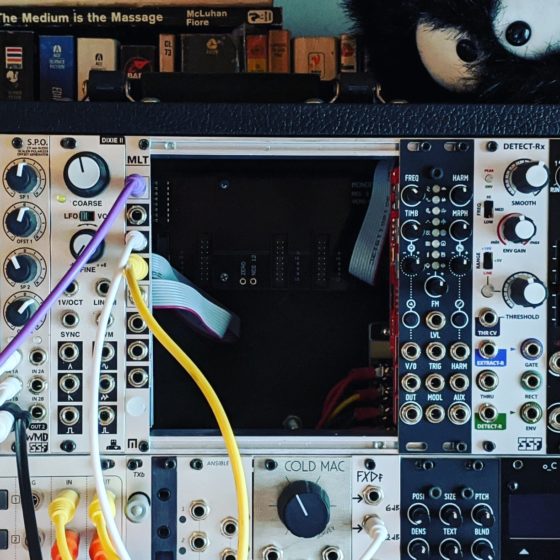
There’s a new void in town. Need to sort out if and with what to fill it. Less on the sound processing side, more on the CV tools side.
There’s a new category on Disquiet.com, in addition to Field Notes, and Downstream, and so forth. It’s Studio Journal, and it’s a place to store away notes (and video, and audio) as I explore music-making. Previously there was a tag called studio journal, but in light of the increased activity I’ve been pursuing with my synthesizer, I figured it’s time to give this material its own section on the website.
I was taking long walks at night until I began to find them unnerving. I’ll start again at some point. The last time I took one coincided with the first episode of season two of Ninth Step Station (created by Malka Older, serialized by Serial Box). That must have been five weeks ago tonight. I stepped out onto the sidewalk after dark and thought, “Yeah, this is what I need. To visit future-Tokyo – you know, even if it’s one plagued by violence and broken into pieces following a devastating war.” I wondered how the sound design would contrast with my walk.
Within a few minutes, I heard something drop behind me. Fully knowing I was listening to a show (it opens in a bar), I looked around. Then, even though all the more aware of the overlap of everyday sound (I was wearing headphones but not noise-canceling ones) and the serial’s sound, I became conscious of a fight in the distance. I got anxious immediately. And again, it was merely sound design experienced on an otherwise empty street. Actually, not “merely.” The opposite of merely. Viscerally.
As the show proceeded, and my experience of the episodes moved from outdoors to indoors, I came to focus on other elements. Indoors, things like bar fights don’t alert me. Indoors, it’s the ambient electronic noises of devices that make me look up, check my phone, tap my earbud.
Note: This is a slight variation (changed to “tonight” from “tomorrow”) of something I published last night in the This Week in Sound email newsletter, and adapted from something looser I’d posted to Twitter awhile back. Twitter being my public notebook.