A Cello Transformed, and Transformed Again

When Henrik Meierkord met Marco Lucchi

“Flacholet” is described by its composer-performer, Henrik Meierkord, who is based in Stockholm, Sweden, as “An organism of cello.” That is apt. The track is as if the cello has taken on a life of its own, a life enabled by some sort of electronic assistance. The slow sawing of the strings is rendered with depth and warmth, and the droning that it yields becomes as much a part of the composition as the originating tones. Halos of sound appear, and textured moments yield brief, sharply defined cameos before fading into the lush lull.

And as it turns out, the track itself has taken on a life of its own, as well. It was picked by by Marco Lucchi, of Modena, Italy, with Meierkord’s consent, and pushed even further into atmospheric realms. “Separasjon” builds on the drone-like qualities of the original, reducing the highs and lows of the drama in favor of something hushed but no less powerful.

“Flacholet” originally posted at [soundcloud.com/enrikeierkord](https://soundcloud.com/enrikeierkord/flacholet). More from Henrik Meierkord at [henrikmeierkord.bandcamp.com](https://henrikmeierkord.bandcamp.com/) and [soundbread.se](https://www.soundbread.se/). “Separasjon” originally posted at [soundcloud.com/marcolucchi](https://soundcloud.com/marcolucchi/henrik-meierkord-marco-lucchi-separasjon). More from Marco Lucchi at [marcolucchi.bandcamp.com](https://marcolucchi.bandcamp.com/). (Meierkord was the cellist featured in the score to the 2018 Oscar-nominated stop-motion animation [*Negative Space*](https://www.youtube.com/watch?v=KI2lsdXJQ40).)

Guitar Through Gates

A trial run

A little after-dinner experimentation, making some headway amid our collective new abnormal. When I post things here I myself recorded, I tag them [studio journal](https://disquiet.com/tag/studio-journal/). Acoustic guitar through randomized sequences of gates. Took awhile to sort a good BPM to align with the strumming: too fast and the chord ended too late; too slow and the gating ended before the chord fully rang out. This is a little first-time experiment with the new Torii script (version 0.3.0) by Steven Noreyko, running on a Fates (aka an open-source Monome Norns port). A Zoom H4n served as the microphone, and that’s a little Boombotix REX speaker in the foreground.

And that is the first time I’ve used my toe to trigger a button on the Fates. I originally wrote “my toe to trigger the Fates” but that sounded ominous

Update: I swapped out the [instagram.com/dsqt](https://www.instagram.com/p/B-GleOlBJt3/) embed of the video for [youtube.com/disquiet](https://www.youtube.com/disquiet).

User Feedback

An ongoing series cross-posted from instagram.com/dsqt

There is an understanding in user-interface work that an individual who clicks on something might further register the action if they experience some manner of feedback resulting from their action. There is also an understanding in user-interface work that succinct messages work best. These two understandings collide at the entrance to this apartment building.

I tried something different this time when I posted the photo. I put it up on Instagram, Facebook, and Twitter and asked people to provide their own captions. A bunch of folks piped up, and I liked these two responses in particular: jdginstagramz (via Instagram): “Self-Captioned.” And Paul Lamere (via [Twitter](https://twitter.com/disquiet/status/1241749177991749634)): “TCP doorbell.”

When Clear Skies Aren’t Blue Sky

Data confirms what the ears were sensing.

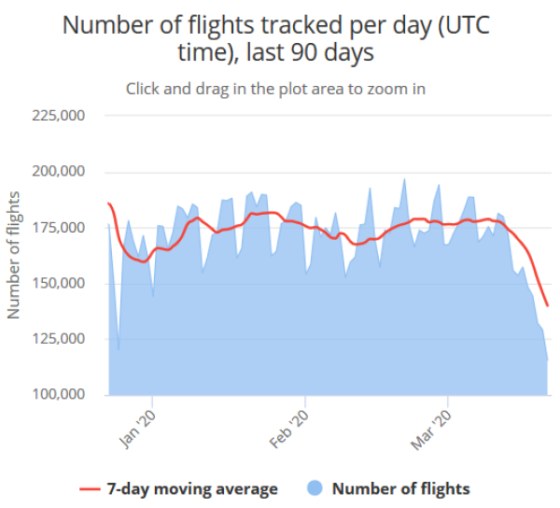
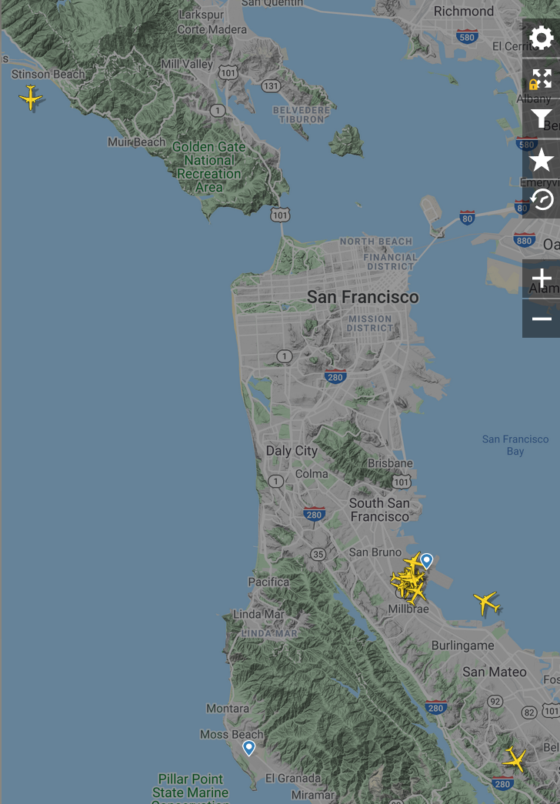
It’s been quiet — understandably so, given the circumstances — in the Richmond District of San Francisco, where I live. I’ve mentioned characteristics of the quiet [previously](https://disquiet.com/2020/03/21/empty-doorbell-cavities/), and wondered about the quiet not just on the ground but [in the air](https://twitter.com/disquiet/status/1241082338169118720). Above is an image of what San Francisco’s airspace looked like this morning as I drank coffee. Below is a chart of the decline in flights globally (as tracked by Flightradar24.com, also the source of the map).

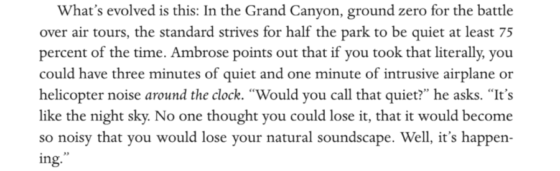
In his book *One Square Inch of Silence: One Man’s Quest to Preserve Quiet*, Gordon Hempton takes the concept of a place on Earth where the sound of a plane does not intrude as a means by which to measure environmental health. He considers not just everyday air traffic like freight and commercial routes, but the unique tension where the planes are a self-contradictory byproduct of nature tourism, such as in the National Parks here in the United States:

And very much to Hempton’s point, the presence of silence has correlated directly with a slowdown of our planet’s machines, flying and otherwise, in reaction to COVID-19. This widely distributed NASA/ESA graphic comparing air quality in Wuhan, China, a year ago and today is clear evidence. (More at [cbs.ca](https://www.cbc.ca/news/technology/covid-19-air-pollution-1.5501810).) Here in the Bay Area, air pollution has already reportedly dropped by 38% ([sfgate.com](https://www.sfgate.com/bayarea/article/air-pollution-lower-coronavirus-impact-sf-15144196.php)).

However, the thing our current quiet has reaffirmed for me, as an admiring if pragmatic reader of Hempton’s book (also recommended: the associated documentary, *Soundtracker*), is that silence is contextual. I’d go so far as to say that silence is synonymous with context; it is the sense, the setting, the environment (using the broader sense of the term) in which life unfolds. An argument attributing restorative qualities to our current quiet would be tough to make. This is a very different quiet, not a presence but a void.