Keeping a Modular Synth Journal

My latest attempt may be a keeper

It’s been just shy of 10 years now that I’ve fiddled with a slowly growing, sometimes contracting, and always morphing modular synthesizer. The playing has greatly informed my work interviewing and collaborating with and writing about musicians — and it’s a lot of fun. I know this anniversary is coming up because Marcus Fischer sent me a photo a few days ago from when I gave a talk in Portland, Oregon, at Powell’s Books, an event at which he performed, along with Brumes (aka Desiree Rousseau) and the OO-Ray (aka Ted Laderas). Fischer used a modular synthesizer for his piece, and the next day he took me by the store Control Voltage, tucked off of N. Mississippi Avenue, to look at what felt to me, for the first time, as meaningfully proximate and approachable — and, yes, enticing.

In the intervening years, I’ve regularly failed at one thing in particular in this regard, which is documenting for myself my experiments with the synthesizer. Recently, I’ve come upon a system that works for me. Now, those last two words are the most important ones: “for me.” There are lots of different ways to track one’s work, and what I’m outlining here is just something that I’ve found works for me. For context, I am a big note-taker, but I am not a big written-note-taker. I jot words on paper regularly, but just as loose fodder for typing. I’ve typed for far too long to be a written-journal keeper. Also, I like the opportunities that computer files provide for searchability and cross-linking.

So, what I use is Obsidian, a free cross-platform document-editing tool that works with files in the markdown (.md) format (if it’s not familiar, more here). I format my synth journal documents very much like the one I use for my daily personal journal, though in this case also employing embedded images. (My personal journal is all text, no pictures — though my success with this Obsidian synth journal may feed back, so to speak, and inform my personal journal efforts down the road.) My system is to keep one file per month, with an entry within that file for each day, including a running checklist of next steps to pursue. (There’s also a separate to-do list for longer-term activities.) The approach yields a page that looks like this:

And if you have had success keeping a synth journal, I’d love to know what works for you.
Music for and from the End

A tribute by Loren Chasse

[bandcamp width=100% height=120 album=4026435703 size=large bgcol=ffffff linkcol=0687f5 tracklist=false artwork=small]

I’m writing this under the assumption that the “sr” to whom the new Loren Chasse track, “The Sun and the Earth Together,” is dedicated is, in fact, the late musician Steve Roden, as the music is very much in the “lowercase” mode that Roden helped pioneer, and because the years in the accompanying liner note, 1964-2023, align with the span of Roden’s time on the planet, as does the characterization of the final phase of his life (that he was “in a long state of transition before passing on this past fall”). It’s a beautiful tribute to Steve (who was also a friend of mine), the cycling passages of droning tones overlapping and drifting. Nearly 12 minutes long, it takes its time, and asks you to drift along with it.

“The Sun and the Earth Together” was released on the Petit Bardo label (petitbardo.xyz), which has also put out work by Francisco López and Gregory Whitehead, among others. Fitting to the subject at hand, half the label’s earnings from sales go “to end of life care organizations.” The label’s modus operandi is a heavy one: “The artists were asked to create a sound work that can be heard by a person in existential finitude (in a relatively short period of time) or a sound work to be heard while someone dies or a sound work that the artists themselves would like to listen to while they die.”

On Repeat

Home/office playlist

On Sundays I try to at least quickly note some of my favorite listening from the week prior — things I’ll later regret having not written about in more depth, so better to share here briefly than not at all.

Wodwo is the alias with which Derbyshire novelist Ray Robinson signs his recorded music. Requiem, released earlier this month, is a collection of alternately somber and wistful instrumental works that each seem to emerge from a thick fog.

[bandcamp width=100% height=120 album=2931609215 size=large bgcol=ffffff linkcol=0687f5 tracklist=false artwork=small]

▰ I’m a sucker for music that sounds like it’s melting, music that supplies an illusion that you’ll never hear it again, that each note is disintegrating in real time, such as in this live piece by the London-based musician who goes by Still Fades. (Of course, it doesn’t disappear. You can replay the video as often as you like.)

Tuonela’s “S&S Drone” has the endlessly sawed strings of a Hollywood score, gaining in intensity as it proceeds, eventually becoming like a threatening swarm of insects. It’s both thrilling and frightening.

▰ “シミ” seems to translate as “stain,” and it’s the title of a new track from the tireless Japanese producer Corruption, who is rapidly reaching the 2,000-recording milestone. It feels like a sampled wooden flute sent through an exteme reverb, but there’s a lot more going on it its brief, half-minute length, what sounds like distant voices and pneumatic street work. As always with Corruption, it is enigmatic to the core.

Scratch Pad: Eno, Fog, Obsidian

From the past week

I do this manually at the end of each week: collating (and sometimes lightly editing) most of the recent little comments I’ve made on social media, which I think of as my public scratch pad. Some end up on Disquiet.com earlier, sometimes in expanded form. These days I mostly hang out on Mastodon (at post.lurk.org/@disquiet), and I’m also trying out a few others. I take weekends and evenings off social media.

▰ I love when a spam call comes through all glitchy and hard to understand, opening with a phrase along the lines of “This is an urgent message from …,” and it’s briefly like a Skynet warning from the future. Until, you know, it’s just spam about some fake loan.

▰ Among my memories of my grandfather is being left, on visits, to rummage through his desk, which always had many coins, many pairs of glasses, and pencils with erasers so old they’d become useless. I now have a desk full of many coins and pairs of glasses. In lieu of old pencils I have dead gadgets.

▰ Day 365 of Duolingo German. Not sure I’m gonna stick with it, but sticking with it for a year was interesting. We’ll see.

▰ Just been thinking about Steve Albini since the news broke. He was many things, but I realize that I think of him first and foremost as a guitarist.

▰ I get a little (a little) better at guitar when I practice guitar regularly, but I don’t get any better at installing firmware when I install firmware regularly, though I suppose my instruments get better.

▰ If you have trouble keeping a journal, I’d suggest starting a file called “tweets-not-sent.txt” and just put much of your negative thinking there rather than online

▰ More power to you keepers of handwritten journals. I’ve typed for too much of my life, starting with my fascination with my parents’ electric typewriter back in the days before my TRS-80. I’ve tried a handwritten synthesizer journal but I keep going back to markdown files with embedded images.

▰ No idea why I waited so long to really regularly use images in my Obsidian markdown notes, but in any case once you do it’s pretty great. The main thing I need to sort out now is a process for managing the images. Do I use one separate folder, or several, or project-specific, or monthly? I dunno.

▰ There’s a new (2024) Buddha Machine, and the creators, Christiaan Virant and 张荐 (Zhang Jian), who collaborate under the name FM3, put the loops up for free (aka “name your price”)

https://buddhamachine.bandcamp.com/album/buddha-machine-se

▰ OK, let’s see if I can get this podcast rolling again

▰ Obsidian (URL: obsidian.md) is, like, amazing, right? So useful. So efficient.

▰ Of course the fog horns piped up Thursday night: Friday, May 10, marks the birthday of the late Ingram Marshall.

▰ In case there was any doubt, the fog horns are still clearly functioning in the San Francisco Bay

▰ Steps:

make music

buy cables

search “cable management”

make music

buy cables

search “cable management”

[repeat]

▰ Who better to follow Brian Eno, godfather of ambient music, than Sleeping Beauty?

End of Week Notes

Four quick items

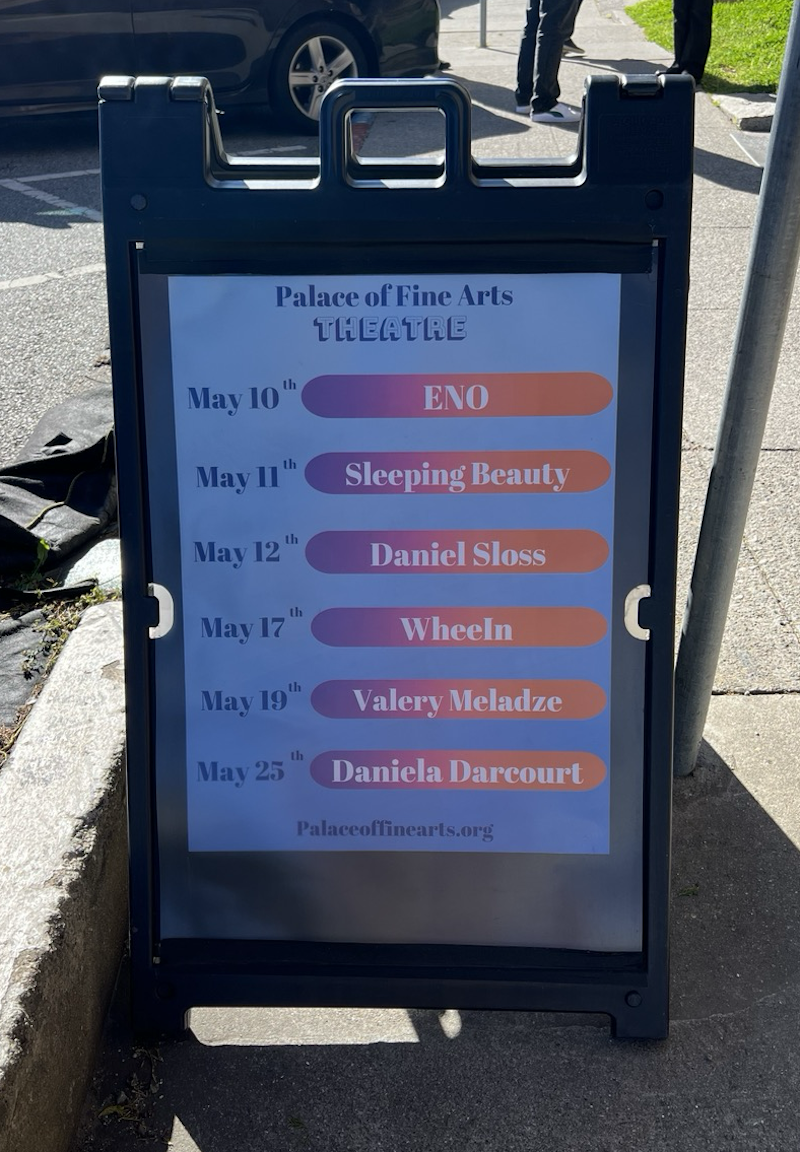
1: I’m going to see the Brian Eno documentary, Eno, this evening at the Palace of Fine Arts Theatre here in San Francisco. As I’ve joked since the movie was announced, I feel like Dieter Rams should have composed the score, since Eno scored the Rams documentary by the same director, Gary Hustwit. Since every showing of Eno is a little different, due to the projection process Hustwit employs, I do plan to see it a second time, but at $40 a pop, I’m going to wait.

2: I’ve been trying to do one audio thing a day, just getting back in the swing of things after spending a way larger percentage of my modest music-making time on guitar practice. This week that included:

  • reorganizing one of my main modular synthesizer racks
  • getting my recently obtained Expert Sleepers ES-9 module hooked up with my laptop and iPad
  • sending audio from the iPad to the synth with the ES-9 (in this case, running it through the excellent reverb module Bunker Archaeology)
  • using some Jacklights to identify activity on some modules so technical their functions have eluded me thus far
  • reminding myself how to use my H4N as an audio interface, and learning by chance that this can be done without batteries (the USB transfers sufficient power to it)
  • I’m trying to get into the habit of ABR (“always be recording) but I’m not quite there yet.

3: I’m plotting the return of my Disquietude podcast. I sent requests out to artists whose music I want to feature, and I quickly (within an hour or so) heard back from most of them. I only feature music by artists who have themselves approved its inclusion, or whose record label or management provided approval.

4: If you haven’t seen the new Paul Simon documentary, In Restless Dreams, I recommend it so far — by “so far” meaning I’m about halfway through the first two episodes. It mostly takes place in the present (and yes, he is quite old, and yes, he seems to be becoming Mel Brooks — and yes, he can still play and sing, boy can he), as a summary of his recent album, Seven Psalms, but also threads a simple chronology of his life. The director is Alex Gibney (The Inventor, Going Clear, We Steal Secrets, Taxi to the Dark Side). There are some exceptional moments, like a hand-drawn grid of the relative chart movements of the top 20 singles made by Art Garfunkel when he was a teenager, a moment when Simon (off screen) tells us he is crying (“weeping”) after summoning up a simple memory, and an instance when Simon recounts going deaf in one ear in October 2023 and at that moment in the film the audio gets muddy in a way that brings the audience into a semblance of his experience. The effect isn’t subtle, but it’s still quite well done. The Garfunkel chart, by the way, is straight outta the “Great Rock and Roll Pauses” section of Jennifer Egan’s A Visit from the Goon Squad (and the related material in The Candy House).