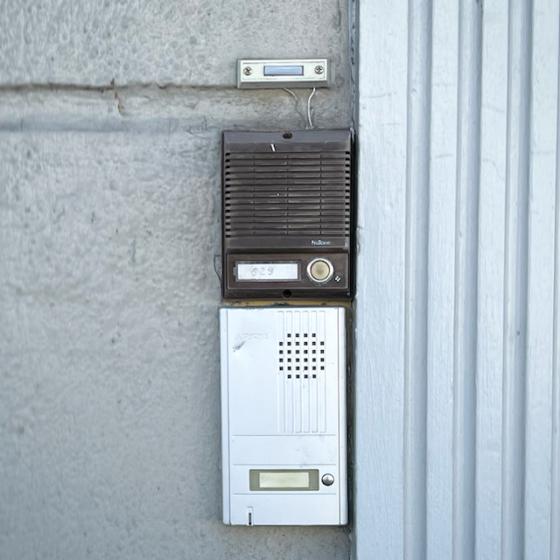
Bleak Triplex

An ongoing series cross-posted from instagram.com/dsqt

Clearly this triplex provides homes for three fierce individualists who — after a lengthy legal engagement, a kind of Bleak Apartment House, or Bleak Coop, or Bleak Tenancy in Common — came to an agreement, co-signed and notarized, that each could select their own doorbell system. Also, clearly, this battle took place long ago. The three devices have weathered the passage of time — or more to the point, been weathered by it. At some point, perhaps a new generation of tenants will initiate a reconciliation, and the archaic buzzers will be replaced by a single system, the uniformity of which will reflect a newfound multi-domestic peace. Until then, the begrudging buzzers maintain an uneasy truce.

twitter.com/disquiet: Expanse Sound, Ikea turntable

From the past week

I do this manually each Saturday, usually in the morning over coffee: collating most of the tweets I made the past week at twitter.com/disquiet, which I think of as my public notebook. Some tweets pop up sooner in expanded form or otherwise on Disquiet.com. I’ve found it personally informative to revisit the previous week of thinking out loud. This isn’t a full accounting. Often there are, for example, conversations on Twitter that don’t really make as much sense out of the context of Twitter itself. And sometimes I tweak them a bit, given the additional space. And sometimes I re-order them just a bit.

▰ I love the readymade poetry of the “notable deaths” page on Wikipedia.

– Russian cosmonaut
– Egyptian film producer and production manager
– Moldovan composer
– Italian hotelier, heart attack

▰ This is some next generation interface that seems to being tested on Twitter. I see it on occasion. Among the weird things about the now five arrows (count ‘em) is the one that seems to mean “I like it” turns red when you click on it, and the red looks more like the Defcon level has gone up.

After a while, even the word ballon starts to look like an arrow.

▰ Based on a recent show at the Oregon Shakespeare Festival, I can confirm that seeing an outdoor production of The Tempest during pouring rain qualifies as an immersive theater experience. One of my fellow attendees called it “method viewing.”

▰ I love how much The Expanse focuses attention on how the ships sound. The immediate context for this moment, from the ninth book in the series, is just how much death and destruction is occurring around the protagonists.

▰ IKEA teamed up with Swedish House Mafia to make a turntable and a desk. When you think about it, isn’t Ikea the Swedish House Mafia? ([engadget.com](https://www.engadget.com/ikea-swedish-house-mafia-record-player-music-desk-144427425.html))

▰ Been down a rabbit hole for a couple weeks. Apparently YouTube has more on it than live videos of John Fahey and Bill Frisell. Who knew? means seriously. Whew. Just breathtaking stuff, Fahey [in 1981](https://www.youtube.com/watch?v=VP08Y3DsJvs).

Peers and Friends Remember Justin Green

In The Comics Journal

John Kelly at The Comics Journal put together [a great memorial](https://www.tcj.com/remembering-justin-green/) to comics artist Justin Green, whose work I edited in Tower Records’ *Pulse!* magazine for many years.

Bookended with pieces by Carol Tyler, Justin’s wife, at the start and, at the end, Catlin Wulferdingen and Julia Green, his daughters, there are entries by Bill Griffith, Denis Kitchen, Kim Deitch, Robert Armstrong, Dan Clowes, Jim, Woodring, Ron Turner, Patrick Rosenkranz, Shary Flenniken, Drew Friedman, Dan Nadel, Paul Karasik, Seth, Mark Newgarden, Glenn Bray, Kayla E., Joe Matt, Glenn Head, Monte Beauchamp, George Hansen, Bruce Chrislip, Jon B. Cooke, Bruce Simon, James Romberger, Steve Powers, John Kinhart, Everett Rand, Robert Beerbohm, and John Paul.

Here is mine:

*Justin Green lived in Sacramento when I did, in the early 1990s. As I write this, it’s been barely a month since he died. I still grieve for my friend who taught me about art and life, emphasis on the “and.” A folder filled with remnants of our collaboration provides some solace.*

*I’d moved from Brooklyn to California’s capital city in 1989, a year out of college, to take a job as an editor at Pulse!, Tower Records’ print magazine. After two years, I suggested to my fellow editors that we experiment with comics in the magazine. The first two artists I signed up were local. Having never edited comics before, I looked for people whom I could work with in person. This was late 1991. Email was rare, cell phones even more so. We spoke by landline, sent faxes, wrote letters, and met in midtown Sacramento cafes like Greta’s and the Weatherstone. The first of these artists was Adrian Tomine, who I knew lived in town because his mailing address appeared in his self-published Optic Nerve, one of numerous minicomics I was buying at the time. The second was Justin Green.*

*I was aware of Justin’s comics from the magazine Raw, the 1991 issue of which listed Sacramento as his location. I tracked him down, and thus began the longest-running comic that Pulse! published, for upwards of a decade. It’s comically—forgive the common pun—absurd that the first two artists I published in Pulse! were so talented, given that I actively, at the beginning, limited myself to locals. It’s also cosmically—pushing the pun further—intriguing that one of them had, decades earlier, produced an ur-text of autobiographical comics, and the other was among the youngest artists pursuing that line of creative activity. Arrangements were formalized at the end of 1991, and their initial Pulse! comics appeared in the first issues of 1992. Justin’s presence in the magazine no doubt helped as I built our roster of contributors, who in time came to include his wife, Carol Tyler.*

*There are a lot of things I could share about working with Justin at such length and regularity. I could talk about his love for glass ink nibs. Or about how he aggressively remade any scripts supplied by writers other than himself (I wrote a few), always for the better. Or about his painstaking use of multiple drafts to refine stories. Or about how the strips’ seemingly most surreal grace notes were often there from the first sketch (whimsy as linchpin). Or about how telling it was, to me, that this elder statesman of underground comics was always open to editorial input, while some far younger artists (not Adrian) flinched and bristled at editing, needing to be sensitively coaxed.*

*The thing I think is important to share in the context of The Comics Journal is how central financial matters were to Justin’s comics. He was, in the truest sense, a working artist. His art (in Pulse!, other commissions, sign painting) was defined by his need to make a living. It’s understood how Justin’s autobiographical work was informed by his religious upbringing. It’s just as important to understand how, in adulthood, practical matters determined and shaped his self-expression. One marvel among many of Justin’s comics is just how much of himself he brought to what was, always, the next job.*

John included four piece of ephemera I shared with him, including two rough drafts and a two-page letter Justin sent me. Here’s one of the rough drafts:

Read the full collection of Green tributes here:

[https://www.tcj.com/remembering-justin-green/](https://www.tcj.com/remembering-justin-green/)

Teal

For hilobrow.com

I read something long ago that Nicholson Baker wrote — I think it was in *The Size of Thoughts* — about how he didn’t change his mind; rather, he’d at some point realize that his mind had changed. It’s in that sense that I woke up one day not long ago and realized that I no longer hated the color teal. That is my #ColorCodeStory for HiLobrow. It begins:

>I’m not saying that teal (or its adjacent tones, a highly concentrated array that I can’t quite distinguish between — I’m probably mistakenly including a solid band of cyan in my personal definition) is my new favorite color. I will say, though, that I disliked teal vehemently for the longest time, associating it to a degree with a certain aspect of Floridian kitsch (redundant?), and that I had a near-lifelong near-visceral negative reaction to teal — and yet recently something changed. And quite suddenly.

Here’s the full piece: [hilobrow.com](https://www.hilobrow.com/2022/06/10/color-code-2/).

MSCTY_Studio x Carl Stone’s Tokyo

Performing live with Nick Luscombe and James Greer

This is a review I wrote that was published in issue 460 of The Wire (June 2022). Watched the archived concert on YouTube.

MSCTY_Studio x Carl Stone’s Tokyo (mscty.space)

You are in Tokyo. The sounds are pure Tokyo: the sweet beeping of public transportation, the routinised cheer of shop keepers’ eager welcomes, the whirring of speedy passing trains, the teeming human chatter, the sheer rush of activity – organic and machine alike.

At some point, however, the quotidian audio takes on a more sinister collective cast. Tokyo is no longer pure. A buzzing vexation rises like radiation fog, up from the sonic floor. What could have been mistaken for a mundane commute slowly morphs into something akin to a psychological thriller. And as with solid thrillers, you might not even recognise the threat until it’s upon you.

What you are hearing is not simply Tokyo. This is, far more specifically, Carl Stone’s Tokyo – the city filtered not only through the machines of an experimental electronic musician, but through the aesthetic perspective of a Los Angeles native who has lived in Japan for two decades.

The occasion is a live stream of that title – “Carl Stone’s Tokyo” – done in collaboration with MSCTY, a “global agency for music + architecture,” per its website, that has worked with everything from Japanese department store Isetan, to the Tallinn Architecture Biennale, to the music industry training nonprofit Saffron. Stone is the prime motivator in this livestream, processing audio that he and MSCTY’s Nick Luscombe and James Greer recorded largely around Nakano, the Tokyo neighbourhood Stone calls home. They join in during the concert.

On the screen, Luscombe and Greer flank Stone, each of the trio with his own laptop, and after a brief chat about sound, place and the changing textures of Tokyo, they dive in. The performance is the first time Stone has worked with either man. The newness lends improvisatory energy. Live streams can be emotionally remote affairs. When the performers take a chance, it can be transformative and elevating.

What begins as a study of human environments worthy of a David Attenborough documentary eventually takes a turn toward John Carpenter territory. That occurs around 20 minutes or so into the performance, when the accumulated density and sheer franticness of the modified recordings reaches a peak. The sounds at that point are layered and filtered beyond mutual distinction, and any semblance of human scale has been pushed well past. It no longer resembles daily life. The sound has become not merely collage but a collage of collages, a forceful amalgam of experiences. Elements that were familiar individually become alien: a Ballardian look below the surface of cultural decorum. The narrative gets a little debatable only at the end, when it neither returns to perceived reality nor reinforces recent auditory challenges.

This is, as Stone states, headphone listening. In the post-performance chat, he likens it to a “22nd century Tokyo” (Luscombe: “hyperreal”). Stone is renowned for his sampling skills, his ability to rework everyday sound and music alike into personal works that are very much his own. (Full disclosure: I’ve shared meals with him in several cities, including Tokyo, and I wrote sleevenotes for one of his Unseen Worlds releases.) Here he is taking environmental sound and warping it into something out of the ordinary. To listen on speakers is to have the environment fill your room, to superimpose two environments. To listen through headphones is to enter Stone’s Tokyo.