
- Familial sonics: baby's snoring on my shoulder, dad's (her grandfather's) from nearby couch. … Yes, plus light hard-drive whir (Tivo's). #
- Reading Kevin Kelley's What Technology Wants on iPod Touch. Trying to sense whether iPod Touch thinks this is appropriate or disrespectful. #
- ♪ Remix (or "experimental rearrangement") of the late Gorecki's Miserere from back in 2008, by DeadHorseMort: http://is.gd/gYyOb #
- RIP, Polish composer Henryk Gorecki (b.1933). #
- Feeding infant bottle outside Exposed exhibit @sfmoma. Feeling surveilled. #
- Anyone seen side-by-side photos of physical keyboard on Droid 2 versus Droid 2 Global? Apparently it's been upgraded. #android #mobileoffice #
- Morning sounds: shower, typing, hard drive, baby breathing, hum (neighbor laundry?), various netlabel releases. #
- Played with new #thicketapp in beta; now upgrading to v2.0 permanently, leaving behind stage-shift surprise in exchange for broader variety. #
- Do Eno's apps beat his albums? Small Craft discussion happening now. Who'd produce Eno well? What's the Warp factor? http://is.gd/gTlWI #
- Gail Wight, whom I interviewed for Nature last year, among artists with linoleum-cut loteria cards in new @sfcb project: http://is.gd/gUTlk #
- The Tuesday-noon city-wide alarm: less alarming than usual. #
- Thanks to Thicket app dev duo @morganpackard & @joshue for participation in interview: http://j.mp/thcktt Video of new version just added. #
- Morning sounds: bus headed downtown, car noise reminiscent of the surf, refrigerator kicking on, hard drive. #
- Evening sounds: dishwasher, laptop hard drive, footsteps, cars (more headed west than east), infant near-sleep babble. #
- Whenever I see the band name Simian Mobile Disco, I mis-read it as Symbian Mobile Disco; attn: @davestewart #
- There goes my evening — Kenneth Silverman's biography of John Cage, Begin Again, just showed up in the mail. #
- Nice. Gentleman Losers' debut album to be reissued by City Centre Offices with "tasty bonus goodies" http://is.gd/gQmxf #
- Ben Bunch's fantastic foam abstractions of video-game controllers & arcade coin-ops @ NYC's Proposition Gallery thru 12/5 http://is.gd/gQc3o #
- Surprising, singing baby to sleep, how useful Grateful Dead songs are. Why? Droney melodies, lengthy lyrics. (So much pop has so few words.) #
- Morning sounds: occasional car, high-pitched whine (various electronics), baby slowly waking (wheez, trumpet, fidget). #
- Nothing like sorting out the office, shifting things around, and finding a snapped computer chip on floor. Wondering now what won't work … #
- "Over the…3 shows in Brisbane, Metallica performed 40 different songs. Only 7 songs…were performed at all 3 gigs." #gratefuldeathmetal #
- Morning sounds: steady rain, and with it how constant pinging creates a sonic image of the physical environs. Plus: slow cars, hard drive. #
- For folks tracking the rich audio metaphors & sonic science in Fringe, next Thursday's episode apparently focuses on mysterious radio signal #
- CRTC has added "new subcategory 36 (Experimental Music)"; distinguishes avant turntablism from beatmatching — for real: http://is.gd/gNaYN #
- Lot of updates in ver 1.0.5 of Reactable mobile: 2 new scenes, Bluetooth headphone, 24-bit wav, beat/bar synchronization http://is.gd/gN9Uh #
Month: November 2010
Craque the Waveform (MP3)
The sine wave isn’t so much a sign of our times as it is a respite from our times, an antidote to sonic abundance and complexity. We’re inundated by an arguably unprecedented degree of sonic consciousness — from sound art to sonically refined consumer products to audio interfaces to writings on sound history and culture. This is why a track such as “FreeoBjecTs” by Craque (aka Southern Californian Matt Cooke-Davis) is such a pleasure. Billed as “free improvisation on homebuilt instruments and looper delays,” it has a refreshingly quiet approach. A good half of its 15 minutes are subtle shades of a waveform coming in and out of focus. Eventually percussion and feedback enter into the picture, but then at a pace that manages to build on the near silence, to supplement it rather than supplant it; .
Track originally posted at soundcloud.com/craque/freeobjects. More on Craque at craque.net.
22Tape’s Broken Instrumental Beats (MP3)
Back in June, 22tape‘s brand of broken instrumental hip-hop drew attention to itself with its bracingly low-key chaos. A recent numbered track, the fifth in a series of untitled instrumentals, confirms the metric imagination of 22tape (aka Jared Dunne, whose profile page lists his physical location as “Chicago/Denver”) as something to keep an ear on.
The track, “Instrumental 5,” has the shape and hallmarks of a standard homebrew beat: looped bits of found recordings, a rough structure suggesting the verses and chorus of an inchoate song, filigrees that lend nuance …
… but unlike a lot of community-forum beats, 22tape’s work truly congeals — the track rewards on repeated listens, as small bits make themselves understood less as neat standalone objects and more as meaningful parts of the composition. An early vocal snippet comes to represent authorial intent, a sampled harp suggests a work’s florid ambition (despite the overall hardened shape of the source material). And the steady string of these untitled instrumentals makes it clear that more work is on the horizon.
For the earlier track mentioned above: disquiet.com. Original “Instrumental 5” track at soundcloud.com. More on Dunne/22tape at 22tape.blogspot.com and myspace.com/22tape.
MP3 Discussion Group: Brian Eno’s ‘Small Craft on a Milk Sea’
 Following a brief hiatus, the Disquiet.com MP3 Discussion Group returns with its first full-length-recording consideration since pondering the reissue of Thomas Köner’s glacial Permafrost, back in August. This time around, we’re deep in the varied chambers of Brian Eno‘s first ever album for Warp Records, Small Craft on a Milk Sea, which is also credited to guitarist Leo Abrahams and to electronic musician Jon Hopkins.
Participating with me in this week’s MP3 Discussion Group are:
Alan Lockett: “I write music reviews and commentary on ambient/drone, the more adventurous end of techno/house, post-dub, and IDM. Based in Bristol, epicentre of the Dub-zone in the Wild West of England, I can mainly be read on igloomag.com and furthernoise.org.”
Julian Lewis: “I write much of Lend Me Your Ears, a UK/Spain-based MP3 blog that appreciates less obvious music.”
Joshua Maremont: “I record as Thermal and pursue my musical and other obsessions in San Francisco.”
Evan Shamoon: “I write about video games for various publications (EGM, PlayStation magazine), and music technology for some others (XLR8R magazine, Switched.com). I also make electronic music as giantmecha, 99.9% of which sits on my hard drive.”
And I’m Marc Weidenbaum; I have run disquiet.com since 1996, and have written for Nature, Down Beat, newmusicbox.org, and other publications; I live in San Francisco.
The conversation will play out in this post’s comments section.
A little note on the MP3 Discussion Group format: This is by no means a closed conversation, so do feel free to join in. The initial posts by participants were all written before they had an opportunity to see each other’s take on the release in question, but after that it’s intended to play out in real time.
More on Brian Eno at brian-eno.net and the Small Craft album at warp.net.
Being Decimal: The Anticipatory Pleasures of the Thicket App
Morgan Packard, the sound half of the development duo that produced the 10-finger interactive audio-visual iOS app Thicket, on composing for interactivity
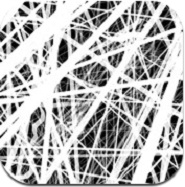 The Thicket app can be understood as many things. An interactive audio-visual delicacy programmed by Morgan Packard (the audio half) and Joshue Ott (the visual half), it is composition and instrument, toy and tool, video art and record album. It runs on the iOS suite of gadgets — the iPad, the iPhone, and the iPod Touch — and turns each of their respective screens into a rarefied sonic playground, one with its own rules and its own rewards.
Thicket presents itself, initially, as a black screen covered with what seem like a nanotech vision of pickup sticks. These myriad razor-thin white lines glisten and bounce around the screen to an elegant score that seems halfway between the gauzy blankness of ambient and the automaton funk of techno. Had Jackson Pollock lived long enough to be a developer on the Atari arcade classic Tempest, it might have looked like this.

Digits, All: Two hands and up to ten fingers can be used to manipulate the Thicket app on the iPad (shown here), the iPhone, and the iPod Touch.
But to touch the screen is to break the score’s fourth wall — to touch the screen is to alter the sound, and the visuals along with it. With each additional finger, the pace of the piece is altered — dragging fingers across the surface brings new patterns. Hold them long enough in the first version of Thicket, and a whole new mixture of sound and image comes into view.
While debugging the second edition of Thicket, version 2.0, which was released today (November 8, 2010), Packard participated in an extended conversation about what Thicket is and what it isn’t: “I don’t want to cross over from creating an interactive art piece which people can explore,” he says, “to creating a completely open-ended tool.”
Perhaps what Thicket is is a peek into a possible future for music, and for video — a future in which a release isn’t a static recording but a malleable one, designed to be played with, prodded, explored. Thicket’s pleasures are real and formidable, but they are also anticipatory, hinting at cultural norms yet to be fully imagined, let alone codified. There’s always a lot of talk in the world of interactive multimedia of 19th-century opera legend Richard Wagner’s Gesamtkunstwerk, the total work that combines all art forms. Thicket is such a work, yet one that never loses sight of its own economy, its own modesty.
iOS Intuition: Video overview of Thicket’s multi-touch functionality by developer Morgan Packard; “one finger works great — up to ten fingers works even better”
Ott, who studied computer graphics, lives in Brooklyn. Packard, who studied anthropology in college and spent some years in the jazz department at the New England Conservatory in Boston, lived in Brooklyn for a decade, but these days makes his home in Denver. Like a lot of people who program, they got their primary education by working. Says Packard, an accomplished electronic musician with several albums to his credit, “I think both of us really cut our teeth coding in the Internet industry.”
Over the course of the interview, Packard talks about how composing music for interactive applications differs from traditional composition (“The idea of retro-fitting a studio production for interactivity gives me shivers”), explains why the second version of Thicket is purposefully less puzzling than its predecessor, and provides a peek inside the Thicket code.
Level Up: A run through Thicket’s new version (2.0), which went live on November 8, 2010.

Marc Weidenbaum: The Thicket app — I’m still sorting out whether to call it a “piece” or a “song,” or what exactly to call it — seems to have a few modes, primarily the white-lined one and then the blue-lined one. I’m trying to get a sense of whether I think of the blue-lined part as a “chorus,” versus the white-line “verse,” or a “bridge.” Do these comparisons sit with you?
Morgan Packard: Honestly, I’ve never really identified strongly with any verse-chorus type of music. My first, intense love was jazz, which tends to have all different sorts of structures, and then I went straight in to focusing on underground dance music, which tends to be steady state music, about the groove, the moment, rather than larger structures like verse and chorus. But the analogy does fit. Especially with the new version of Thicket [version 2], which has more modes and an easier way to transition between them; I find myself alternating back and forth in a way that feels like different sections of the same musical piece.
Weidenbaum: Regarding the new version of Thicket, what did you learn from the first version that led you to update it as you did?
Packard: Some of the changes in the new version are in response to problems we identified, and some of them are just us wanting to add more stuff, make it a fuller, deeper experience. The biggest difference is in the mode system. In the first version of Thicket, there were three distinct modes, which you entered based on a fairly obscure calculation based around how active your fingers were. This worked OK, but was confusing to people, and sometimes felt arbitrary. You’d be having fun in one mode, and all of a sudden, you’re thrown into a different visual and sound world. I sometimes found it annoying, actually. The new version has none of those surprise mode changes. You change modes by simply rotating the device. It’s much nicer now, being able to control how the modes change.
Continue reading “Being Decimal: The Anticipatory Pleasures of the Thicket App”