Distillation of Chop Shop exhibit in three white noise cycles
/ By Marc Weidenbaum
With characteristic low-key aplomb, the Touch podcast series has uploaded an edited live recording of a sound art installation, and kept it unburdened — for better or worse — by much in the way of contextual information. A white-noise effect is in full effect throughout, like the sonic result of one very large, weighty cymbal continuously excited by some low-level mechanical action (MP3). In fact, though, it’s a very different resonant surface. A brief liner note explains this much: “Live room installation capture recording from October 2010 at SONM: Puertas de Castilla in Murcia, Spain. A trio of identical speaker constructions were presented in a black box room, all fed with variations of a similar sonic bed to continuously run for a duration of 24 days. Three cycles distilled here for this listen.” The installation, titled “Dark Matter (Ebb Tide),” is credited to longstanding speaker musician Chop Shop, aka Scott Konzelmann.
“Nightly No.1” by melynabarzdis plays with jazz components in a fascinating manner. Foregrounded is a slow piano line that seems to leave a synthesized vapor haze wherever the melody takes it, a haze of smokey aura that deep in the distance reconstitutes in the form of a reflective saxophone solo. The combined effort is a duet of sorts, but a duet as if between two musicians on either side of a massive courtyard who find themselves collaborating long after dark, when they’re both surprised to find the other exists, let alone is awake. As for the tiny little pixel-damage modulations that shift the notes up and down, side to side, at unexpected moments, they lend a broader frame, suggesting this as incidental music to some sort of neo-noir, all overcoats and tricorders.
¶ Beyond Bunker Broadcasts: Ambient musician Mark Rushton has been trying to use Google+ Hangouts “as a way to broadcast live or on YouTube, in unedited form.” Rushton has a great brain for music distribution. Between his website, his podcast, and his SoundCloud work alone, he’s a model of the individual who manages to be productive creatively while still experimenting regularly with infrastructure. He’s made some notes on his blog about using the Hangouts’ Studio Mode, which, according to Google, “optimizes your individual audio for music instead of conversation.” Rushton discusses various issues, some technical, some relating to the potential audience: “the potential boredom of looking at somebody looking at computers.”
¶ Orchestral-tronic: Chicago-based composer Olivia Block has posted an excerpt from her forthcoming album, Foranum Magnum. Performed by Chicago Composers Orchestra, it’s a mix of Ligeti/Feldman-style spectral density and the low-level percussion of what could be shuffling feet.
¶ Screen Sound: “Since your display is flexible ”“ it could be able react to the sound vibrations as you speak. So why not put a laser microphone behind the display to capture those vibrations, and get rid of traditional mic holes?” That’s unwiredview.com reporting on a recently revealed Apple patent application (found via macrumors.com). From the patent: “The internal component may be an output device such as a speaker that transmits sound through the flexible display or an actuator that deforms the display in a way that is sensed by a user. The internal component may also be a microphone or pressure sensor that receives sound or pressure information through the flexible display.” The question that should always linger with patents is the unintended consequences. When Apple announced that the new iPhone 5 would have three microphones, coders live-commenting via Twitter sat up straight for a moment and pondered the potential uses. As for a screen that doubles as speaker and microphone, what opportunities are there — could what’s on the screen impact the sound, could intense visual activity in some way serve as a kind of filter, could the whole thing end up a useful or otherwise artistic feedback system? View the patent: patentscope.wipo.int. Here’s an image from the patent:
¶ In Brief: … Blue Fringe: Update to recent post on the use of music in the first episode of the new season of Fringe: the theme that the Dr. Walter Bishop character summons up during interrogation, as a means to concentrate, is “Song for the Unification of Europe”by composer Zbigniew Preisner, from the movie Blue (1993), directed by Krzysztof KieÅ›lowski: “Resolving the Sonic Themes in Fringe.” … Glass (Re)Works: That remix album of Philip Glass‘ music featuring Beck, Tyondai Braxton, Amon Tobin, and others mentioned here recently is now streaming in its entirety at npr.org. It’s part of the ongoing Glass-at-75 celebrations, and there is an app in the works as well (it’s by Scott Snibbe Studio, best known for the development of Björk’s Biophilia. … Genre Ceasefire: Just as a side note, it’s interesting that Beck is mentioned as an exemplar of the rockist side of cultural life in a recollection by Tim Munro of the ensemble eighth blackbird. He’s discussing how he was the classical kid, always fighting with his brother, the rock kid, about the relative merits of their pastimes: “While other mothers worried that their kids were doing drugs or having sex, our mother was defusing brawls about the relative superiority of Ligeti and Beck.” The post is from the blog at eighthblackbird.org (found via rgable.typepad.com).”
A play on the composer's name on his 100th birthday
/ By Marc Weidenbaum
The latest from the great Resting Bell netlabel is a two-track, 25-minute set by Rick Tarquinio titled Waves. Things are buried beneath these waves, in particular the first track. A lush, lightly melodic piece (MP3), it’s reportedly built on a note sequence derived from the last name of composer John Cage, who would have turned 100 this year. No doubt Cage, a fan of such wordplay as mesostic, would have appreciated both the piece’s affect and its provenance. The second track is a wonderfully sedate meditation on the melodica (MP3). In the composer’s description of the album as a whole, “Waves uses minimal source material arranged accidentally into long pieces meant to evoke waves coming ashore.”
Poster and details regarding the Disquiet Junto concert to be held in Manhattan on November 27
/ By Marc Weidenbaum
This is the splendid logo/poster that’s part of the upcoming Apex Art exhibit As Real as It Gets, organized by Rob Walker, for which I’m handling sound design aspect, largely through the collective efforts of the Disquiet Junto. Per the date on the poster, there will be a live Disquiet Junto concert event at Apex Art in Manhattan on November 27, the Tuesday after Thanksgiving. The beautiful image is by Oliver Munday:
The list of participants in the concert will become public as the event approaches.
In a post at his Design Observer blog (“Listening to Retail”), Walker gets into some detail about what we’re up to. The exhibit overall is a fascinating exploration of the “fictional products, imaginary brands, hypothetical advertising and speculative objects.”
Disquiet Junto, under Marc’s direction, will create “sonic branding”on behalf of an imaginary retailer: The Ladies’ Paradise, the seduction-machine of a department store at the center of Zola’s 1883 novel of the same name. More precisely, we’re positing a sort of contemporary iteration of the store — maybe you could say, “If the Ladies’ Paradise were real and existed today, how would this unique retail brand sound?”
He’s been keeping an enthusiastic, curious, and sensitive ear on the Junto projects as they’ve developed:
I’ve found the listening experience to be totally fascinating, drawing into aural focus details like the mad peeping of a battery of checkout counters at a busy store, an unanswered phone that never stops ringing, the processed voices of official announcements (“Please follow the instructions on the pinpad”) and the murmer and chatter of shoppers. (All this became particularly interesting to me as I lost track of which were real field recordings, and which were artificial.)
I didn’t really realize how much the listening experience here had affected me until I found myself in a waiting room recently, at our veterinarian’s office. The machine sounds of the air conditioning, the interlocking but disconnected out-of-sight conversations, the mysterious and clicks and clunks I couldn’t actually identify: Suddenly it was all crystal clear, and oddly riveting.


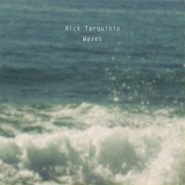 The latest from the great Resting Bell netlabel is a two-track, 25-minute set by Rick Tarquinio titled Waves. Things are buried beneath these waves, in particular the first track. A lush, lightly melodic piece (