Following a brief hiatus, the Disquiet.com MP3 Discussion Group returns with its first full-length-recording consideration since pondering the reissue of Thomas Köner’s glacial Permafrost, back in August. This time around, we’re deep in the varied chambers of Brian Eno‘s first ever album for Warp Records, Small Craft on a Milk Sea, which is also credited to guitarist Leo Abrahams and to electronic musician Jon Hopkins.
Participating with me in this week’s MP3 Discussion Group are:
Alan Lockett: “I write music reviews and commentary on ambient/drone, the more adventurous end of techno/house, post-dub, and IDM. Based in Bristol, epicentre of the Dub-zone in the Wild West of England, I can mainly be read on igloomag.com and furthernoise.org.”
Julian Lewis: “I write much of Lend Me Your Ears, a UK/Spain-based MP3 blog that appreciates less obvious music.”
Joshua Maremont: “I record as Thermal and pursue my musical and other obsessions in San Francisco.”
Evan Shamoon: “I write about video games for various publications (EGM, PlayStation magazine), and music technology for some others (XLR8R magazine, Switched.com). I also make electronic music as giantmecha, 99.9% of which sits on my hard drive.”
And I’m Marc Weidenbaum; I have run disquiet.com since 1996, and have written for Nature, Down Beat, newmusicbox.org, and other publications; I live in San Francisco.
A little note on the MP3 Discussion Group format: This is by no means a closed conversation, so do feel free to join in. The initial posts by participants were all written before they had an opportunity to see each other’s take on the release in question, but after that it’s intended to play out in real time.
Morgan Packard, the sound half of the development duo that produced the 10-finger interactive audio-visual iOS app Thicket, on composing for interactivity
/ By Marc Weidenbaum
The Thicket app can be understood as many things. An interactive audio-visual delicacy programmed by Morgan Packard (the audio half) and Joshue Ott (the visual half), it is composition and instrument, toy and tool, video art and record album. It runs on the iOS suite of gadgets — the iPad, the iPhone, and the iPod Touch — and turns each of their respective screens into a rarefied sonic playground, one with its own rules and its own rewards.
Thicket presents itself, initially, as a black screen covered with what seem like a nanotech vision of pickup sticks. These myriad razor-thin white lines glisten and bounce around the screen to an elegant score that seems halfway between the gauzy blankness of ambient and the automaton funk of techno. Had Jackson Pollock lived long enough to be a developer on the Atari arcade classic Tempest, it might have looked like this.
Digits, All: Two hands and up to ten fingers can be used to manipulate the Thicket app on the iPad (shown here), the iPhone, and the iPod Touch.
But to touch the screen is to break the score’s fourth wall — to touch the screen is to alter the sound, and the visuals along with it. With each additional finger, the pace of the piece is altered — dragging fingers across the surface brings new patterns. Hold them long enough in the first version of Thicket, and a whole new mixture of sound and image comes into view.
While debugging the second edition of Thicket, version 2.0, which was released today (November 8, 2010), Packard participated in an extended conversation about what Thicket is and what it isn’t: “I don’t want to cross over from creating an interactive art piece which people can explore,” he says, “to creating a completely open-ended tool.”
Perhaps what Thicket is is a peek into a possible future for music, and for video — a future in which a release isn’t a static recording but a malleable one, designed to be played with, prodded, explored. Thicket’s pleasures are real and formidable, but they are also anticipatory, hinting at cultural norms yet to be fully imagined, let alone codified. There’s always a lot of talk in the world of interactive multimedia of 19th-century opera legend Richard Wagner’s Gesamtkunstwerk, the total work that combines all art forms. Thicket is such a work, yet one that never loses sight of its own economy, its own modesty.
iOS Intuition: Video overview of Thicket’s multi-touch functionality by developer Morgan Packard; “one finger works great — up to ten fingers works even better”
Ott, who studied computer graphics, lives in Brooklyn. Packard, who studied anthropology in college and spent some years in the jazz department at the New England Conservatory in Boston, lived in Brooklyn for a decade, but these days makes his home in Denver. Like a lot of people who program, they got their primary education by working. Says Packard, an accomplished electronic musician with several albums to his credit, “I think both of us really cut our teeth coding in the Internet industry.”
Over the course of the interview, Packard talks about how composing music for interactive applications differs from traditional composition (“The idea of retro-fitting a studio production for interactivity gives me shivers”), explains why the second version of Thicket is purposefully less puzzling than its predecessor, and provides a peek inside the Thicket code.
Level Up: A run through Thicket’s new version (2.0), which went live on November 8, 2010.
Marc Weidenbaum: The Thicket app — I’m still sorting out whether to call it a “piece” or a “song,” or what exactly to call it — seems to have a few modes, primarily the white-lined one and then the blue-lined one. I’m trying to get a sense of whether I think of the blue-lined part as a “chorus,” versus the white-line “verse,” or a “bridge.” Do these comparisons sit with you?
Morgan Packard: Honestly, I’ve never really identified strongly with any verse-chorus type of music. My first, intense love was jazz, which tends to have all different sorts of structures, and then I went straight in to focusing on underground dance music, which tends to be steady state music, about the groove, the moment, rather than larger structures like verse and chorus. But the analogy does fit. Especially with the new version of Thicket [version 2], which has more modes and an easier way to transition between them; I find myself alternating back and forth in a way that feels like different sections of the same musical piece.
Weidenbaum: Regarding the new version of Thicket, what did you learn from the first version that led you to update it as you did?
Packard: Some of the changes in the new version are in response to problems we identified, and some of them are just us wanting to add more stuff, make it a fuller, deeper experience. The biggest difference is in the mode system. In the first version of Thicket, there were three distinct modes, which you entered based on a fairly obscure calculation based around how active your fingers were. This worked OK, but was confusing to people, and sometimes felt arbitrary. You’d be having fun in one mode, and all of a sudden, you’re thrown into a different visual and sound world. I sometimes found it annoying, actually. The new version has none of those surprise mode changes. You change modes by simply rotating the device. It’s much nicer now, being able to control how the modes change.
The Stonesthrow label’s weekly sample melees recently migrated to the sound-file community soundcloud.com from the cloud-storage service drop.io (the latter of which is due to be shut down, following its acquisition by Facebook). It will be interesting to see how, if at all, the backend-technology shift influences the ongoing competitions. For now, it’s difficult to think of a significant downside to the move away from drop.io.
That’s nothing against drop.io; the service had regularly improved its interface over time. But one of the major benefits of the Soundcloud interface is that each participating musician will have a distinct personal page, so if a listener enjoys one track, it will be all the easier to locate other tracks by the same person. When the Stonesthrow Beat Battles were on drop.io, collating the various contributors felt a bit like being a character on the AMC TV series Rubicon, trying to track down information on mysterious figures who post coded missives online and leave a disparate and disconnected approximation of a data trail.
Beat Battle #192 is happening right now, which gives us time to focus on the well-attended #191. For readers just coming upon the idea of a Beat Battle, the way it works is that all the participants have a set amount of time, a little less than a week, to construct a beat (that is, a hip-hop-oriented backing track) based on a shared sound source. For contest #191, that sample was a bit of mellow instrumental pop jazz by Don Julian and the Larks (aka the Meadowlarks), titled “Just Tryin’ to Make It.” With a lightly swinging rhythm and a sweet lead saxophone, the track had numerous sample-able moments. Beatmaking tends to fall into two camps: reworking known music and crate-digging for rarities. The Larks track falls into the latter camp.
To these ears, the winner of #191 should have been Cambridge, Massachusetts-based Tictoc, who took the enjoyably subdued tune and torqued it into a noisily looping monster, somewhere between the skronk symphonies of Glenn Branca and the dense collages of Public Enemy:
Track originally posted at soundcloud.com. Original contest announcement, with link to source audio, at stonesthrow.com.
Speaking of the demise of drop.io, there was a piece by PC Magazine‘s John C. Dvorak (at pcmag.com) about the (much reported but still not yet in effect) demise of drop.io, in which he decried the fragility of a cloud-based Internet ecology: “It’s like a bone yard. Blame the cloud. You’ve basically wasted years of effort saving cool Web sites with bookmarks for no reason.” The piece is worth a reading, though it offers no apparent solution. It also begs the question, are dead links a massive problem? Putting all your data in one basket, as it were, is a problem, but that’s true whether the basket is in the cloud or in your basement server. Either way, it’s an avoidable one; drop.io only had so much impact on the Internet, but imagine Flickr.com suddenly going belly-up. In addition, there’s a mistaken fetish quality to the perceived eternal nature of links; maybe there’s something to be said for data that disappears.
It’s wait and see for now on how the Stonesthrow switch to Soundcloud from drop.io will play out. It seems like a win for participants and listeners, but perhaps the relative loss of anonymity won’t prove to be a boon — maybe the looseness of drop.io-era gave producers reassurance that their copyright-meddlesome habits wouldn’t be easily trackable, and the Soundcloud mode will be less attractive. For now, the Beat Battles go on.
Angry Birds may be funnier with sound off. No grunting, wheezing or cheering. Just a Road Runner desert and much well-timed physical comedy. #
Hope early visitors for Seeing Orange: Dutch Design Week SF think orange-lit buildings honor Koolhaas, Wanders, Baas & Co http://is.gd/gFT9J#
If full copy of Put Me in the Zoo were as out of registration as the violet spread, it'd be on a shelf next to Carsten Nicolai's Moiré Index #
Want to read "Put Me in the Zoo" by Robert Lopshire to my baby. End up explaining what "out of registration" means. #
Election hangover: wake to find I agree w/ Scalia: "You are asking us to create a whole new prohibition?" http://is.gd/gFCP1 re: vidgame law #
New Neal Stephenson essay "Atoms of Cognition: Metaphysics in the Royal Society" in Bill Bryson”“edited Seeing Further http://is.gd/gCFmB#
.@apfrod May very well take you up on interview dare. These kick-interface Fisher Price toys are like Dance Dance Revolution for infants. in reply to apfrod#
Not sure what @michaelpachter means re: Nintendo DS being "under assault" by iOS. They make beautiful music together http://is.gd/gCDNs :) #
More Rip Van Winkle than Groundhog Day, we wake up and Tipper Gore has returned dressed as Arnold Schwarzenegger http://is.gd/gCD1U#
Kids in the street banging pots and pans. No, the Travel Channel isn't playing the background. The Giants have won. #
Non-stop election fund-raising pleas cause PBS pledge-month flashbacks; keep getting audio-visual hallucinations of John Tesh at Red Rocks. #
Zimoun, sound poet of the DC motor, moves from pastic and metal to the world of cardboard. Video: http://is.gd/gAgdQ#
First electronic music in baby's heavy rotation is by anonymous chiptune musicians at Fisher Price. #
Many hours of the day, I get email newsletters from one or another newspaper from somewhere in the world where it is, at that moment, noon. #
Pre-order up for new @buddhamachine ("generation iii") — with pictures: http://is.gd/gzTc5 Four extended loops, all played on qin (zither). #
Relieved that @stonesthrow has migrated its Beat Battles to @soundcloud in advance of the shutdown of drop.io. #
Used to cheers during Giants-Rangers games while out & about. Sense sonic isolation at home. Just checked MLB score for 1st time in my life. #
Strange 21c commerce hybrid — auditioning hip-hop/r&b instrumentals on YouTube via phone app before purchasing 12"s. #
RT @pheezy Listening to a variety of late-night hums: power supply, refrigerator, air filter, disk drives and traffic. #eartwit#
RIP, George Hickenlooper (Factory Girl, Hearts of Darkness) — please say hi to John Linck for me. #
Hear marching band practice from shopping-mall parking lot: drums echoed, horns muted, timpani piercing. Like a Just Blaze beat, but live. #
Sold my Technics 1200s, same weekend as rumors float, again, of production stop. #
.@catchfoot Morning sounds, yeah, always with the hard drives. I've got to get better at tweeting from my flash-driven phone and iPod Touch. #
Drone music draws as easily and commonly from natural sounds as it does from electronic ones, just as it does from noise and from traditional instrumentation, often intertwining the seemingly disparate elements. The cello drone in electronic music can trace its roots at least as far back as David Darling and Hank Roberts, two musicians who used electronic effects to expand their instruments — “expand” in the sense that it is sometimes applied to cinema, a mode now associated closely with Zoë Keating and Ted (Oo-Ray) Laderas, among others.
The drones of Peregrino, aka Muñiz, Argentina’s Bernardo Durand, aren’t necessarily rooted in the cello, but they are frequently rooted in deep, reverberant strings that could pass for a cello in a dark alley. The intonations may get lost in the blissed-out murk of “En la vieja cabaña, la ventana clausurada,” the third track off his recent netlabel release, El azul helado del albal, but elsewhere on the record they are prominent, especially in the album’s opening track and keeper, “En una habitación oscura” (MP3).
[audio:http://www.archive.org/download/rb089/01-En_una_habitacion_oscura.mp3|titles=”En una habitación oscura”|artists=Peregrino]
The strings make themselves heard shortly after the outset, following which they’re balanced by a rich molasses of sound (the “murk” mentioned above, lovingly), and by bell-like tones that seem to shudder in slow motion. It’s fascinating to take a step back from the track, which is entrancing enough to get lost in, and recognize how those strings seem to pierce the surrounding audio as they arise, as if their sound is too complicated, too rich and singular, to be fully subsumed.
El azul helado del albal was released last month on the netlabel restingbell.net.
Durand runs the bilingual netlabel ahoraeterno.com.ar from Buenos Aires. It appears, based on an entry from the label’s blog, ahoraeternorecs.blogspot.com, that the cover to El azul helado del albal, shown up top, was photographed on a recent train trip.

 Following a brief hiatus, the Disquiet.com MP3 Discussion Group returns with its first full-length-recording consideration since pondering the reissue of Thomas Köner’s glacial Permafrost, back in August. This time around, we’re deep in the varied chambers of Brian Eno‘s first ever album for Warp Records, Small Craft on a Milk Sea, which is also credited to guitarist Leo Abrahams and to electronic musician Jon Hopkins.
 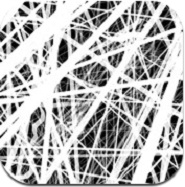 The Thicket app can be understood as many things. An interactive audio-visual delicacy programmed by Morgan Packard (the audio half) and Joshue Ott (the visual half), it is composition and instrument, toy and tool, video art and record album. It runs on the iOS suite of gadgets — the iPad, the iPhone, and the iPod Touch — and turns each of their respective screens into a rarefied sonic playground, one with its own rules and its own rewards.

 Drone music draws as easily and commonly from natural sounds as it does from electronic ones, just as it does from noise and from traditional instrumentation, often intertwining the seemingly disparate elements. The cello drone in electronic music can trace its roots at least as far back as David Darling and Hank Roberts, two musicians who used electronic effects to expand their instruments — “expand” in the sense that it is sometimes applied to cinema, a mode now associated closely with Zoë Keating and Ted (Oo-Ray) Laderas, among others.