Music from Music for Airports (MP3)

Last Friday, the Bang on a Can All-Stars performed the group’s transcriptions of Brian Eno‘s Music for Airports with the Kronos Quartet. The show was part of a marathon of concerts, which was part of the ongoing 150th-anniversary celebration of Massachusetts Institute of Technology, where the event was staged. In advance of the show, Bang on a Can bassist Robert Black submitted to an interview (MP3) on the radio show Here & Now, during which he was asked by the host, “How does that work, when this was something that was technology initially?”

[audio:http://audio.wbur.org/storage/2011/04/hereandnow_0415_brian-eno-bang.mp3|titles=”Interview About Music for Airports”|artists=Robert Black of Bang on a Can]

The question’s a good one. The Bang on a Can exercise takes music that’s an early example of studio-as-instrument, a process that blurs the roles of recording, composing, and performing, and retroactively assigns the resulting music to a traditional musical score. Black doesn’t fully answer the question, but he does set up what the Eno was up to, and how the composers divided up the task: “Music for Airports was a piece that was really sort of a seminal listening experience for most of the people in Bang on a Can. So, the four sections of that — each composer that founded Bang on a Can, Michael Gordon, David Lang, Julia Wolfe, and Evan Ziproryn, they each took one of those sections and then it was up to them to orchestrate it for the All Stars.”

The interview is about 10 minutes long, and while it may not be fully satisfying in explaining how the transcriptions function, it does provide helpful background, and side-by-side examples of the original music and the Bang on a Can rendition. Interview originally posted at hereandnow.wbur.org.

Sketches of Sound 13: Owen Freeman

Every month since April 2010, Disquiet.com has hosted a project called “Sketches of Sound,” in which illustrators are invited to draw a sound-related object. I post the drawing as the background of my Twitter account, twitter.com/disquiet, and then share a bit of information about the illustrator back on Disquiet.com. Call it “curating Twitter.”

For the 13th entry, Owen Freeman graciously volunteered. I’ve followed his illustration blog for some time, and it was when he posted some moody work he’d done for Wardour Securities and Investment Review that I was inspired to contact him.

Freeman is an illustrator and designer for print, editorial, and advertising. He grew up in the Pacific Northwest and worked as a graphic designer before leaving to study illustration at the Art Center College of Design, where he graduated with distinction in 2009. His work has appeared in Communication Arts, American Illustration, and Creative Quarterly as well as Taschen’s Illustration Now! 3 and Illustration Now! Portraits. He has lived and worked in Los Angeles and London. He’s currently based on the West Coast of the U.S. And he’s at twitter.com/owenfreeman and 24houremergency.blogspot.com.

The previous “Sketches of Sound” contributors were, in alphabetical order, Brian Biggs, Leela Corman, Warren Craghead III, Dylan Horrocks, Megan Kelso, Minty Lewis, Natalia Ludmila, Darko Macan, Justin Orr, Hannes Pasqualini, Thorsten Sideb0ard, and Gustavo Alberto Garcia Vaca.

Fish Head(phone) MP3

Before reading anything about this track, just give it a listen. Know that it’s by Richard Devine, the electronic musician known for his aggressive exploration of new recording technolgy, his appetite for the latest audio software, and his expansive work in sound design.

That is, despite a surface reading of Devine’s resume, not a chaotic system whipped up in a beta edit of a generative-audio toy for the iPad, nor is it a live performance document from a European music festival. It is an unedited survey of the life under the surface of the water in Crystal Waters, Florida, where Devine recently spent time with a hydrophone.

He writes:

We took a boat out to … specific locations including Kings Point Bay, Shell Island, and Mouth of Rainbow River. Here we captured some bizarre sounds of Dolphins communicating, thousands of shrimp feeding, and the distant moan of the Hypostomus Plecostomus catfish.

“Headphones,” he adds, “highly recommended.” The listening provides a strong parallel between the complexity of the natural world and the complexity of the composed, abstract one. For related listening, here’s an earlier field recording by Devine: maggots.

The above image accompanied the hydrophone recording at soundcloud.com/richarddevine.

The Pendulum and the Letterpress

An essay to accompany the work Competitive Swinging by Paolo Salvagione

The artist Paolo Salvagione has been principal engineer on the clock of the Long Now Foundation since he joined the project in 2000 (or, as they count over at the Long Now, the year 02000). In his spare time, his own artwork fuses the conceptual and the mechanical, to varying relative degrees. He asked me to write an essay to accompany an installation he debuted yesterday, April 17, at the Headlands Center for the Arts in Marin County, just across the Golden Gate Bridge from the Richmond District, where I live in San Francisco.

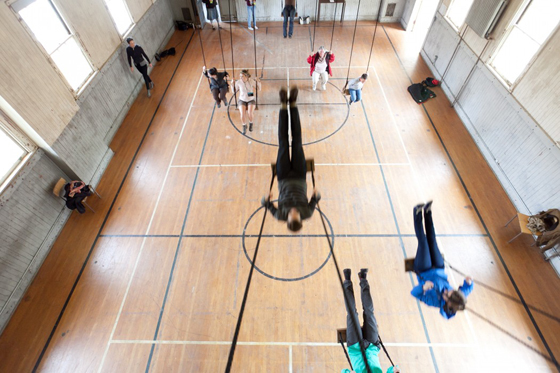
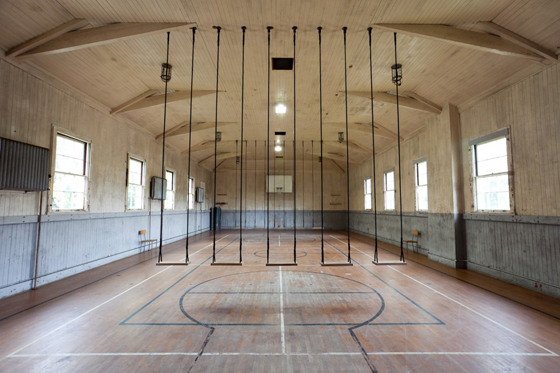
Salvagione’s work is titled “Competitive Swinging,” and it resulted from an invitation he accepted to use the historic gymnasium, building 952, at the Headlands, which is based in the decommissioned Fort Barry military grounds, the structures on which date from 1907. “Competitive Swinging” consists of two sets of five swings set facing each other. The hardware from which each swing is suspended was reproduced by Salvagvione, who based the design on that of the original (and long in decay) equipment in the ancient facility. (When asked, on the phone, how they are doing, whereas most people will say “well,” Salvagione tends to respond “welding.”)

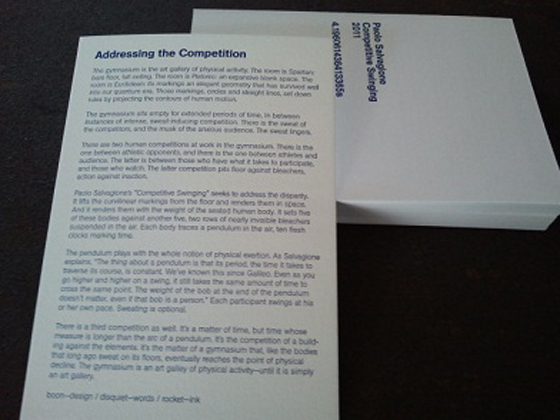
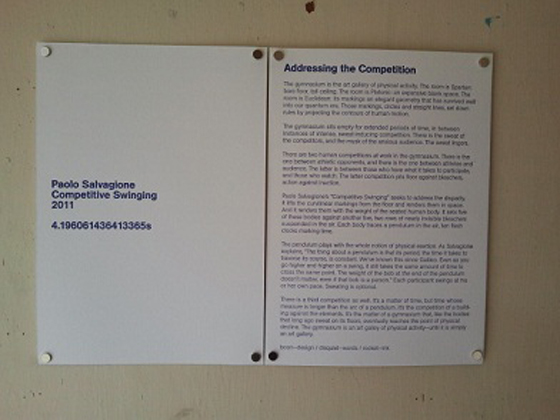
His invitation to me to contribute an essay came with an enticement: it would be printed on A5 cardstock on a letterpress by Rocket Caleshu of the San Francisco Center for the Book (sfcb.org), from a design by Brian Scott. (That’s Scott of Boon Design, boondesign.com, which among other things created the “cover” art for the Disquiet.com compilations Our Lives in the Bush of Disquiet and Anander Mol, Anander Veig.)

Here’s the text I wrote:

“Addressing the Competition”

The gymnasium is the art gallery of physical activity. The room is Spartan: bare floor, tall ceiling. The room is Platonic: an expansive blank space. The room is Euclidean: its markings an elegant geometry that has survived well into our quantum era. Those markings, circles and straight lines, set down rules by projecting the contours of human motion.

The gymnasium sits empty for extended periods of time, in between instances of intense, sweat-inducing competition. There is the sweat of the competitors, and the musk of the anxious audience. The sweat lingers.

There are two human competitions at work in the gymnasium. There is the one between athletic opponents, and there is the one between athletes and audience. The latter is between those who have what it takes to participate, and those who watch. The latter competition pits floor against bleachers, action against inaction.

Paolo Salvagione’s “Competitive Swinging” seeks to address the disparity. It lifts the curvilinear markings from the floor and renders them in space. And it renders them with the weight of the seated human body. It sets five of these bodies against another five, two rows of nearly invisible bleachers suspended in the air. Each body traces a pendulum in the air, ten flesh clocks marking time.

The pendulum plays with the whole notion of physical exertion. As Salvagione explains, “The thing about a pendulum is that its period, the time it takes to traverse its course, is constant. We’ve known this since Galileo. Even as you go higher and higher on a swing, it still takes the same amount of time to cross the same point. The weight of the bob at the end of the pendulum doesn’t matter, even if that bob is a person.” Each participant swings at his or her own pace. Sweating is optional.

There is a third competition as well. It’s a matter of time, but time whose measure is longer than the arc of a pendulum. It’s the competition of a building against the elements. It’s the matter of a gymnasium that, like the bodies that long ago sweat on its floors, eventually reaches the point of physical decline. The gymnasium is an art galley of physical activity — until it is simply an art gallery.

Images of the letterpress version of my essay:
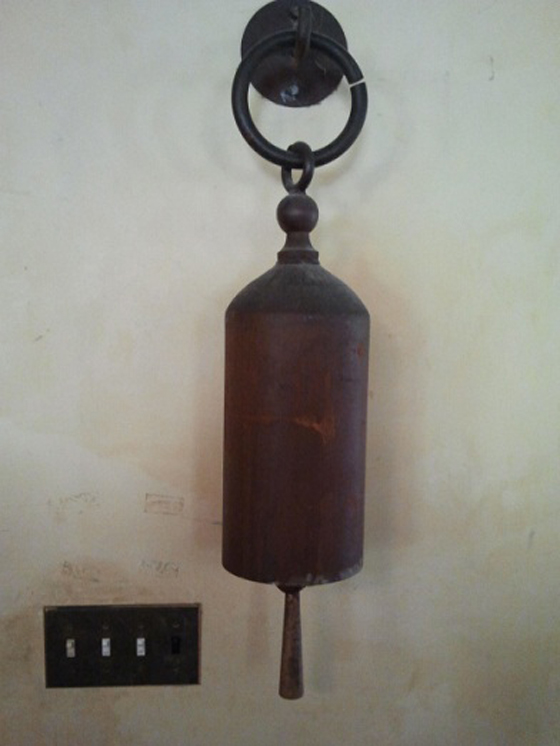
Unrelated, but this mass of sonorous rust is the bell in the communal kitchen at the Headlands:
The three installation photos by Andria Lo (andrialo.com).

Decidedly Unchipper Chiptune (MP3)

Three months in a row, which is something of a record at least for the past year or so, the hexawe.net netlabel has served up healthy doses of unhealthy chiptune-derived music. The MP3s on Hexawe tend to veer from the retro, chipper arcade simulacra that defines much chiptune and instead head headfirst into noisier climes. As heard on Thrash Bandicoot‘s “Threat,” this isn’t a matter of common noise (MP3), of so-called (mistakenly so, if it must be said) unmusical sounds, but instead of disparate impulses. Stitched together into a suite-like format are elements of fuzzy bass and echoed vocal snippets, and techniques ranging from sudden junctures to a sense of counterpoint that verges on randomness.

[audio:http://www.hexawe.net/hex0037_threat_by_thrash_bandicoot.mp3|titles=”Threat”|artists=Thrash Bandicoot]

More on the netlabel at hexawe.net. Thrash Bandicoot is the duo of Kool Skull (Juan Larrazabal, soundcloud.com/koolskull) and Droid Song (Jack Taylor). Many of the numerous samples heard here are courtesy, wittingly, of Chalices of the Past (soundcloud.com/chalices-of-the-past).